My 4th Quarter Outside Reading Book

from whatcouldzoosbe.files.wordpress.com/2007/08/life-of-pi.jpg
Monday, March 31, 2008
Week 5 Post B
I believe that the strongest and most important part of a story is the main conflict. In The Road by Cormac McCarthy, the main conflict is that of a father and son struggling to survive in a barren land which takes a tole on their relationship and love. This main conflict always kept me wanting to read more of the book and find out what will happen next. At one point in the story however, the father and son find a secret emergency bunker filled with food, clothing and everything that they would need to survive. I was let down at this turn of events because the main conflict had temporarily been resolved. For this section of 30 or so pages, it was very painful to read and it seemed slow and boring. For me, there was no main conflict, no suspense, no hunger and no struggle to survive. Eventually, the father and son are forced to move on and face the elements again but I was confused why McCarthy put that part in the story. I do not feel that it was a good use of writing because all it did was temporarily suspend the main conflict and all the action that made the story interesting and suspenseful. I am not however, criticizing the setting or most of the plot. I enjoy reading about the father and the son but I feel that this particular portion of the story could have been left out.

Week 5 Post A
Definitions
Tableau (77)-a picturesque grouping of persons or objects; a striking scene.
Bedlam (82)-a scene or state of wild uproar and confusion.
Figurative Language
"He looked at the house an he looked out over the dripping countryside an then let the door back down and descended the steps and set about making breakfast"(130) This is a little like personification but humans can't exactly "drip" so I would call this more of a metaphor. Even though McCarthy doesn't spend a lot of time describing the father's viewpoint, this sentence brings memories of camping and all of the times I have been wet and miserable. I can relate to the feelings that the father and son are going through.
"The faintly lit hatchway lay in the dark of the yard like a grave yawning at judgment day in some old apocalyptic painting"(131)
"The boy going ahead with a broom and clearing the way of sticks and branches and the man bent over the handle of the cart watching the road fall away before them"(131) McCarthy uses clever personification to describe the monotonous journey to the ocean from the father's point of view. It is almost like the races I compete in and how I pick a spot in the road as a short term goal and use that to reference my long term progress. This is how I imagined what the father and son must have been doing.
Quote
I know you thought we were going to die.
Yeah.
But we didn't.
No.
Okay.
Here is another example of McCarthy's dialogue. It is hard for a majority of writers to write about death and being close to death because it is often times hard for the reader to relate. In this case, McCarthy keeps the discussion of death simple and straight forward.
Theme
Throughout the novel, the son always asks his father about good and bad. One theme that reoccurs in the story is that of good, and the temptations of evil. The father and son's journey is a test to see if they can remain "the good guys" and not give in to the bad. These tests include ravaging hunger, opportunities to take advantage of people and mental hardships that test their will.
Tableau (77)-a picturesque grouping of persons or objects; a striking scene.
Bedlam (82)-a scene or state of wild uproar and confusion.
Figurative Language
"He looked at the house an he looked out over the dripping countryside an then let the door back down and descended the steps and set about making breakfast"(130) This is a little like personification but humans can't exactly "drip" so I would call this more of a metaphor. Even though McCarthy doesn't spend a lot of time describing the father's viewpoint, this sentence brings memories of camping and all of the times I have been wet and miserable. I can relate to the feelings that the father and son are going through.
"The faintly lit hatchway lay in the dark of the yard like a grave yawning at judgment day in some old apocalyptic painting"(131)
"The boy going ahead with a broom and clearing the way of sticks and branches and the man bent over the handle of the cart watching the road fall away before them"(131) McCarthy uses clever personification to describe the monotonous journey to the ocean from the father's point of view. It is almost like the races I compete in and how I pick a spot in the road as a short term goal and use that to reference my long term progress. This is how I imagined what the father and son must have been doing.
Quote
I know you thought we were going to die.
Yeah.
But we didn't.
No.
Okay.
Here is another example of McCarthy's dialogue. It is hard for a majority of writers to write about death and being close to death because it is often times hard for the reader to relate. In this case, McCarthy keeps the discussion of death simple and straight forward.
Theme
Throughout the novel, the son always asks his father about good and bad. One theme that reoccurs in the story is that of good, and the temptations of evil. The father and son's journey is a test to see if they can remain "the good guys" and not give in to the bad. These tests include ravaging hunger, opportunities to take advantage of people and mental hardships that test their will.
Tuesday, March 4, 2008
Week 4 Post B
Dear Cormac McCarthy,
I know for watching your interviews with Opera in L.A. class that you do no google yourself so you will probably never see this. I wanted to start off by analyzing the two books of yours that I have read. All the Pretty Horses and The Road have both won many awards but I feel that they have two different writing styles. Yes, both books use the same method of dialogue but The Road uses shorter sentences and simple metaphors to convey the feelings of the two main characters whereas All the Pretty Horses uses many long and sometimes paragraph-like sentences to describe feelings and setting. Both styles do an excellent job of providing the reader enough information and make the book interesting to read. I was also shocked to see the contrast in settings between the two books. Most writers have a certain era that they prefer to write in and you seem to break the status quo with your books ATPH and The Road. ATPH takes place in the 1900's which is more than one hundred years apart from the setting of The Road and its post-apocalyptic setting. I enjoyed both books, the differences between them and I look forward to reading more of you books in the future.
I know for watching your interviews with Opera in L.A. class that you do no google yourself so you will probably never see this. I wanted to start off by analyzing the two books of yours that I have read. All the Pretty Horses and The Road have both won many awards but I feel that they have two different writing styles. Yes, both books use the same method of dialogue but The Road uses shorter sentences and simple metaphors to convey the feelings of the two main characters whereas All the Pretty Horses uses many long and sometimes paragraph-like sentences to describe feelings and setting. Both styles do an excellent job of providing the reader enough information and make the book interesting to read. I was also shocked to see the contrast in settings between the two books. Most writers have a certain era that they prefer to write in and you seem to break the status quo with your books ATPH and The Road. ATPH takes place in the 1900's which is more than one hundred years apart from the setting of The Road and its post-apocalyptic setting. I enjoyed both books, the differences between them and I look forward to reading more of you books in the future.
Week 4 Post A
Definitions
trellis (75)-a framework of this kind used as a support for growing vines or plants.
parsible (76)- I wasn't able to find a definition for this word. Oddly enough, dictionary.com didn't recognize the word.
idiom (75) -A speech form or an expression of a given language that is peculiar to itself grammatically or cannot be understood from the individual meanings of its elements
Figurative language
"Stood looking where the last of that ragged horde seemed to hang like an afterimage in the disturbed air" (78). The slaves that McCarthy describes have a large effect on the father and son. To the father, the horde symbolizes what will happen to himself if he should stop fighting against the harsh elements.
"The boy's candle colored skin was all but translucent. With his great staring eyes he'd the look of an alien" (109). McCarthy uses a metephor here to emphasize the desperate situation that the father and son are in. Any modern day person looking at these two main characters must feel that they do look like aliens because of their lack of hygiene and food.
"Steam was coming off of him like smoke" (124). This is another simple simile that reminded me of elementary school in Michigan. The first thing that every kid does when it is cold outside is huff at the air and watch the steam rise from their mouth pretending to smoke a cigarette.
Quote
"The world shrinking down about a raw core of parisble entities... More fragile than he hould have thought. How much was gone already? In time to wink out forever" (75).
Theme
The two main characters haven't had anything to eat in a couple weeks. The underlying themes of family and friendship still endure however, now both the father and the son seem to be counting down the days until they die. Their progress and will haven't faltered but they carry on knowing that they are walking themselves to their death.
trellis (75)-a framework of this kind used as a support for growing vines or plants.
parsible (76)- I wasn't able to find a definition for this word. Oddly enough, dictionary.com didn't recognize the word.
idiom (75) -A speech form or an expression of a given language that is peculiar to itself grammatically or cannot be understood from the individual meanings of its elements
Figurative language
"Stood looking where the last of that ragged horde seemed to hang like an afterimage in the disturbed air" (78). The slaves that McCarthy describes have a large effect on the father and son. To the father, the horde symbolizes what will happen to himself if he should stop fighting against the harsh elements.
"The boy's candle colored skin was all but translucent. With his great staring eyes he'd the look of an alien" (109). McCarthy uses a metephor here to emphasize the desperate situation that the father and son are in. Any modern day person looking at these two main characters must feel that they do look like aliens because of their lack of hygiene and food.
"Steam was coming off of him like smoke" (124). This is another simple simile that reminded me of elementary school in Michigan. The first thing that every kid does when it is cold outside is huff at the air and watch the steam rise from their mouth pretending to smoke a cigarette.
Quote
"The world shrinking down about a raw core of parisble entities... More fragile than he hould have thought. How much was gone already? In time to wink out forever" (75).
Theme
The two main characters haven't had anything to eat in a couple weeks. The underlying themes of family and friendship still endure however, now both the father and the son seem to be counting down the days until they die. Their progress and will haven't faltered but they carry on knowing that they are walking themselves to their death.
Subscribe to:
Comments (Atom)
My outside reading book

From: books.beloblog.com/archives/roadhardcover.jpg
The Rising Tied Album
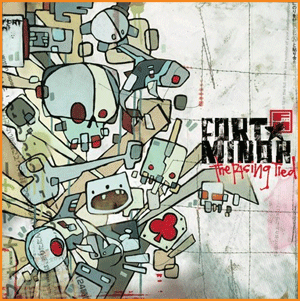
From: http://asianvariations.com/images/fortminor-album.gif
My outside reading book

From: www.illiterarty.com/files/www.illiterarty.com/img/119/a_thousand_splendid_suns.jpg