Cormac McCarthy is such a stud. Not only could he possibly be related to me, but his writing style is truly unique. McCarthy uses an abstract writing style that keeps the details down to a minimum but still manages to get themes of love and survival across, all in small paragraphs. He also rarely uses quotation marks, which takes some getting used to, however i feel that it is a clever stylistic choice that makes the dialogue between the father and the son significant even though they are the only two characters in the whole book. Here is an example.
Did you have any friends?
Yes. I did.
Lots of them?
Yes.
Do you remember them?
Yes. I remember them.
What happened to them?
They died.
All of them?
Yes. All of them.
Do you miss them?
Yes. I do.
McCarthy doesn't follow the conventional quoting rules but it is still clear to the reader who is speaking. McCarthy is able to to this because there are only two characters in the book at this point; the father and son. Through this technique, McCarthy is able to give each character a unique voice while keeping the actual words spoken down to a minimum.
My 4th Quarter Outside Reading Book

from whatcouldzoosbe.files.wordpress.com/2007/08/life-of-pi.jpg
Tuesday, February 26, 2008

Week 3 Post A
Definitions
Cormac McCarthy's writing style uses many unconventional words that I seldom encounter. As a result, I may have more definitions than just two.
Basalt (30)-he dark, dense igneous rock of a lava flow or minor intrusion, composed essentially of labradorite and pyroxene and often displaying a columnar structure.
Piedmont (40)-a plateau between the coastal plain and the Appalachian Mountains, including parts of Virginia, North Carolina, South Carolina, Georgia, and Alabama.
Penitent (46)-Roman Catholic Church. a person who confesses sin and submits to a penance.
Figurative language
Following a stone wall in the dark, wrapped in his blanket, kneeling in the ashes like a penitent."(46). I didn't know what a penitent was, however using the context I was able to guess that it was some sort of religious person. The word "like" made it a simile which was an easy target for my figurative language section of my blog. Describing the father as a penitent shows the weakness and the vulnerability that he is going through. McCarthy uses small scenes like these to characterize the father and son in unique and interesting ways.
Reflecting back the sun deep in the darkness like a flash of knives in a cave"(35). This quote sounds like a nice and thoughtful simile however, McCarthy is actually describing dead bodies in the bottom of a semi truck and comparing them to knives in a cave. Pretty delicious ehh?
"He shoved the pistol in his belt and slung the knapsack over his shoulder and picked up the boy and turned him around and lifted him over his head and set him on his shoulders and set off up the old roadway at a dead run, holding the boy's knees, the boy clutching his forehead, coved with gore and mute as stone"(56). Contrary to popular belief, I didn't use this quote solely because it is a very long quote. The figurative language at the end of the quote is more significant to the reader if it is given in context. McCarthy describes the boy as "mute as stone" to show the state of shock that he is in. His father has just murdered a random traveler and now the two are running for their lives.
Quote
"He wiped the blood from his face and held him. It's okay, he said. It's okay"(57). OMG! The father has just killed his first victim. He is clearly turning into a psychopathic killer who will stop at nothing to drink the blood of others.
Theme
The main theme at this point in the book is simple, run for your freekin lives. Or if you want a more English oriented equivalent of that last sentence, every man for himself.
Cormac McCarthy's writing style uses many unconventional words that I seldom encounter. As a result, I may have more definitions than just two.
Basalt (30)-he dark, dense igneous rock of a lava flow or minor intrusion, composed essentially of labradorite and pyroxene and often displaying a columnar structure.
Piedmont (40)-a plateau between the coastal plain and the Appalachian Mountains, including parts of Virginia, North Carolina, South Carolina, Georgia, and Alabama.
Penitent (46)-Roman Catholic Church. a person who confesses sin and submits to a penance.
Figurative language
Following a stone wall in the dark, wrapped in his blanket, kneeling in the ashes like a penitent."(46). I didn't know what a penitent was, however using the context I was able to guess that it was some sort of religious person. The word "like" made it a simile which was an easy target for my figurative language section of my blog. Describing the father as a penitent shows the weakness and the vulnerability that he is going through. McCarthy uses small scenes like these to characterize the father and son in unique and interesting ways.
Reflecting back the sun deep in the darkness like a flash of knives in a cave"(35). This quote sounds like a nice and thoughtful simile however, McCarthy is actually describing dead bodies in the bottom of a semi truck and comparing them to knives in a cave. Pretty delicious ehh?
"He shoved the pistol in his belt and slung the knapsack over his shoulder and picked up the boy and turned him around and lifted him over his head and set him on his shoulders and set off up the old roadway at a dead run, holding the boy's knees, the boy clutching his forehead, coved with gore and mute as stone"(56). Contrary to popular belief, I didn't use this quote solely because it is a very long quote. The figurative language at the end of the quote is more significant to the reader if it is given in context. McCarthy describes the boy as "mute as stone" to show the state of shock that he is in. His father has just murdered a random traveler and now the two are running for their lives.
Quote
"He wiped the blood from his face and held him. It's okay, he said. It's okay"(57). OMG! The father has just killed his first victim. He is clearly turning into a psychopathic killer who will stop at nothing to drink the blood of others.
Theme
The main theme at this point in the book is simple, run for your freekin lives. Or if you want a more English oriented equivalent of that last sentence, every man for himself.
Tuesday, February 19, 2008
Week 2 Post B
Often times, we like to think that women are exactly the same as men when it comes to roles in society. But even when women have the same constitutional rights as men, our society still sets out different standards for men and women. For example, we generally think it is ok for a women to stay at home and take care of the house. In fact, it is considered a sign of wealth if a wife can stay home. However, if a husband stays home while the mother works, people would think it's creepy and that the husband is down right lazy. From the knowledge I have gained from my AP World class, this has been happening since the very beginning of time in Mesopotamia (Not that the AP Euro students would know this TOM AND AMY!) The two genders have always played unique roles in the development of society but the males in each culture seem to dominate. I am not saying that males are better, I'm simply saying that women and men aren't as equal as we would like them to be.
Week 2 Post A
Definitions
Primrose(26)- any plant of the genus
Sectarian(28)- narrowly confined or limited in interest, purpose, scope, etc.
Figurative language
"Everything was alight. As if the lost sun were returning at last. The snow orange and guivering. A forest fire was making its way along the tinderbox ridges above them, flaring and shimmering against the overcast like the northern lights"(27). Cormac McCarthy isn't afraid to expres his thoughts and feelings in short and disconnected sentences. In this quote, McCarthy strings together three or four similes that describe the terraine around him. The land he describes is actually very bleak and grey but by using the similies, he is able to draw the reader's attension to the little details that give the father hope.
Quote
"Slogging to the edge of the road with hhis back to the child where he stood bent with his hands on his knees, coughing. He raised up and stood with weeping eyes. On the gray snow a fine mist of blood"(26). Yeah Son! My hat is off to the father for sucking it up and dealing with the pain he is going through. I don't have a clue what is wrong with the father, but he can't show his son that he is sick otherwise both of them will lose moral. Pain=good and Tom=Noob.
Theme
Not much has changed in the last 10 pages that I read. The bond between the father and son seems to be crucial to their survival. The father continues to push on through the baren and snowy land in hopes of finding a better life, and keeping his son alive. His son counts on his dad to get him through the difficult challenges that they face. Together, both of them count on eachother and depend on eachother to survive.
Primrose(26)- any plant of the genus
Sectarian(28)- narrowly confined or limited in interest, purpose, scope, etc.
Figurative language
"Everything was alight. As if the lost sun were returning at last. The snow orange and guivering. A forest fire was making its way along the tinderbox ridges above them, flaring and shimmering against the overcast like the northern lights"(27). Cormac McCarthy isn't afraid to expres his thoughts and feelings in short and disconnected sentences. In this quote, McCarthy strings together three or four similes that describe the terraine around him. The land he describes is actually very bleak and grey but by using the similies, he is able to draw the reader's attension to the little details that give the father hope.
Quote
"Slogging to the edge of the road with hhis back to the child where he stood bent with his hands on his knees, coughing. He raised up and stood with weeping eyes. On the gray snow a fine mist of blood"(26). Yeah Son! My hat is off to the father for sucking it up and dealing with the pain he is going through. I don't have a clue what is wrong with the father, but he can't show his son that he is sick otherwise both of them will lose moral. Pain=good and Tom=Noob.
Theme
Not much has changed in the last 10 pages that I read. The bond between the father and son seems to be crucial to their survival. The father continues to push on through the baren and snowy land in hopes of finding a better life, and keeping his son alive. His son counts on his dad to get him through the difficult challenges that they face. Together, both of them count on eachother and depend on eachother to survive.
Wednesday, February 13, 2008
Tuesday, February 12, 2008
Week 1 Post B
"Can I ask you something? he said.
Yes. Of course.
Are we going to die?
Sometime. Not now."
This quote happens just before the father and son go to bed in the middle of a barren field that is covered in ash. Although the reader doesn't know how old the son is, we are able to see that he is very scared and anxious about what is going to happen to them. The father, in this case, is asked an extremely difficult question but answers honestly, calmly and lovingly. I believe that most parents, when put in the same situation, would reassure their children that they will never die but the father from McCarthy's novel comes up with a clever way of giving the truth, without letting his son panic. McCarthy describes very little physical characteristics of the father and son but from quotes like these, we can see that the father has a very strong bond with his son to the point where he would sacrifice anything for him. I look forward to reading this book to find more about the nuclear devastation and how it effects the relationship between the father and son.
Yes. Of course.
Are we going to die?
Sometime. Not now."
This quote happens just before the father and son go to bed in the middle of a barren field that is covered in ash. Although the reader doesn't know how old the son is, we are able to see that he is very scared and anxious about what is going to happen to them. The father, in this case, is asked an extremely difficult question but answers honestly, calmly and lovingly. I believe that most parents, when put in the same situation, would reassure their children that they will never die but the father from McCarthy's novel comes up with a clever way of giving the truth, without letting his son panic. McCarthy describes very little physical characteristics of the father and son but from quotes like these, we can see that the father has a very strong bond with his son to the point where he would sacrifice anything for him. I look forward to reading this book to find more about the nuclear devastation and how it effects the relationship between the father and son.
Week 1 Post A
Definitions
glaucoma(3)-bnormally high fluid pressure in the eye, most commonly caused either by blockage of the channel through which aqueous humor drains
flowstone(3)-a layered deposit of calcium carbonate, CaCO3, left by thin sheets of flowing water, as in a cave.
granitic(3)-a coarse-grained igneous rock composed chiefly of orthoclase and albite feldspars and of quartz, usually with lesser amounts of one or more other minerals, as mica, hornblende, or augite.
congeal(4)-to change from a soft or fluid state to a rigid or solid state, as by cooling or freezing.
Figurative language
"The lamp in the rocks on the side of the hill was little more than a mote of light"(8). This is a metaphor because Cormac McCarthy describes it as a "mote" although it is clearly not. This is an excellent comparison because of all the smoke and ash caused by the nuclear fallout in suffocating the lamp's light to a point where it is just a dull glow in the night.
"He caught [the snowflake] in his hand an watched it expire there like the last host of Christendom(13). I don't know the exact word for this type of figurative language but McCarthy references Christendom in his book to give the reader a connection to the characters in the book. The reference helps the reader see the father and son more as normal people rather than characters in a fictional nuclear war.
Quote
"You forget what you want to remember and you remember what you want to forget(10). This just stuck me as an interesting quote that I thought was ironically true. In the father's case, he has already suffered terrible losses and the quote signifies an emotional reality. However, I enjoyed this quote because it seems that on tests at school I always seem to remember the stuff that isn't on the test and forget the stuff that is.
Theme- So far, we know very little about the father and his son but we do know that they are the last two people alive in their area. One theme seems to be that love can carry a person through anything. At one point in the novel, the father goes to the extreme when he answers a question from his son saying, "If you died I would want to die too"(9).
glaucoma(3)-bnormally high fluid pressure in the eye, most commonly caused either by blockage of the channel through which aqueous humor drains
flowstone(3)-a layered deposit of calcium carbonate, CaCO3, left by thin sheets of flowing water, as in a cave.
granitic(3)-a coarse-grained igneous rock composed chiefly of orthoclase and albite feldspars and of quartz, usually with lesser amounts of one or more other minerals, as mica, hornblende, or augite.
congeal(4)-to change from a soft or fluid state to a rigid or solid state, as by cooling or freezing.
Figurative language
"The lamp in the rocks on the side of the hill was little more than a mote of light"(8). This is a metaphor because Cormac McCarthy describes it as a "mote" although it is clearly not. This is an excellent comparison because of all the smoke and ash caused by the nuclear fallout in suffocating the lamp's light to a point where it is just a dull glow in the night.
"He caught [the snowflake] in his hand an watched it expire there like the last host of Christendom(13). I don't know the exact word for this type of figurative language but McCarthy references Christendom in his book to give the reader a connection to the characters in the book. The reference helps the reader see the father and son more as normal people rather than characters in a fictional nuclear war.
Quote
"You forget what you want to remember and you remember what you want to forget(10). This just stuck me as an interesting quote that I thought was ironically true. In the father's case, he has already suffered terrible losses and the quote signifies an emotional reality. However, I enjoyed this quote because it seems that on tests at school I always seem to remember the stuff that isn't on the test and forget the stuff that is.
Theme- So far, we know very little about the father and his son but we do know that they are the last two people alive in their area. One theme seems to be that love can carry a person through anything. At one point in the novel, the father goes to the extreme when he answers a question from his son saying, "If you died I would want to die too"(9).
Monday, February 4, 2008
Remember The Name Son!
Soundtrack to The Odyssey
Song name: Remember The Name
Artist: Fort Minor
Album: The Rising Tied
The one word that relates Telemachus to Remember the name is: underdog. We see in the novel that the suiters criticize Telemachus and his effort to find his father. The early transformation of Telemachus shows his effort to try to become more confident as a man and more comfortable with who he is. He often appears to be alone socially and in his beliefs which is demonstrated by the suiters when the refuse to leave Telemachus' house. His underdog status encourages the reader to root for him and keep reading to see what happens.
Similarly, the song Remember The Name, describes a young rapper who is trying to make it in the music business, but no one will even bother to give him a chance.
Mike! - He doesn't need his name up in lights
He just wants to be heard whether it's the beat or the mic
He feels so unlike everybody else, alone
In spite of the fact that some people still think that they know him
But no, he knows the code
It's not about the salary
It's all about reality and making some noise
Making the story - making sure his clique stays up
That means when he puts it down Tak's picking it up! Let's go!
Like Telemachus, the person Fort Minor is describing doesn't want fame or fortune but rather wants people to hear what he has to say and to take him seriously. Both "characters" have amazing tallent at what they do but are frequently underestimated in their abilities. Telemachus gets put down by the suiters while the character in Remember the Name has a hard time getting respect from his family and others because he raps.
Song name: Remember The Name
Artist: Fort Minor
Album: The Rising Tied
The one word that relates Telemachus to Remember the name is: underdog. We see in the novel that the suiters criticize Telemachus and his effort to find his father. The early transformation of Telemachus shows his effort to try to become more confident as a man and more comfortable with who he is. He often appears to be alone socially and in his beliefs which is demonstrated by the suiters when the refuse to leave Telemachus' house. His underdog status encourages the reader to root for him and keep reading to see what happens.
Similarly, the song Remember The Name, describes a young rapper who is trying to make it in the music business, but no one will even bother to give him a chance.
Mike! - He doesn't need his name up in lights
He just wants to be heard whether it's the beat or the mic
He feels so unlike everybody else, alone
In spite of the fact that some people still think that they know him
But no, he knows the code
It's not about the salary
It's all about reality and making some noise
Making the story - making sure his clique stays up
That means when he puts it down Tak's picking it up! Let's go!
Like Telemachus, the person Fort Minor is describing doesn't want fame or fortune but rather wants people to hear what he has to say and to take him seriously. Both "characters" have amazing tallent at what they do but are frequently underestimated in their abilities. Telemachus gets put down by the suiters while the character in Remember the Name has a hard time getting respect from his family and others because he raps.
Subscribe to:
Comments (Atom)
My outside reading book

From: books.beloblog.com/archives/roadhardcover.jpg
The Rising Tied Album
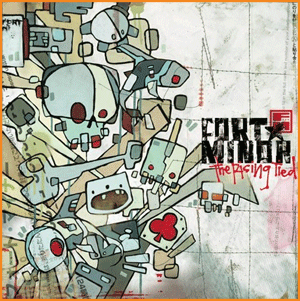
From: http://asianvariations.com/images/fortminor-album.gif
My outside reading book

From: www.illiterarty.com/files/www.illiterarty.com/img/119/a_thousand_splendid_suns.jpg