My 4th Quarter Outside Reading Book

from whatcouldzoosbe.files.wordpress.com/2007/08/life-of-pi.jpg
Tuesday, May 27, 2008
Week 7 Post B
Well, Pi has finally made it to land and he is off the horrible boat that he was confined to for almost 300 days. The book states that his boat washed up on the shores of Mexico. I am not sure how Pi ended up in Mexico but it seems like an unlikely spot to land. When Columbus first followed the winds and currents to the Americas, he hit many island before even reaching Mexico. It took many more years and expeditions for people of his time to get to Mexico. For this reason, I doubt that Pi would randomly wash up on the shores of Mexico without first stopping at some of the other hundred islands. Overall, as the end of this book approaches, I was somewhat disappointed. The overall story had a unique plot but it was a little too unbelievable for my taste. The setup that Yann Martel uses put too much emphasis on Pi's faith. I understand that this is presented as a large portion of the book on purpose but it has negative effects on the book as a whole. Consequently, the book moves painfully slow and failed to gain my sympathy for Pi because of his religious antics. If I had to rate this book I would give it a 6-7 because it has a unique plot but moved too slowly and included too much useless information.

Week 7 Post A
It is astounding to think that Pi has been at sea for 227 day. Chapter 31 includes many famous cast aways however none of their circumstances come close to Pi's predicament. He attributes his success to the fact that he is constantly kept busy physically and spiritually. He prays for most of his day aboard the vessel keeps his mind from thinking about subjects such as his dead family or even his own death. The tiger, believe it or not, is also playing a part in Pi's survival. Although he appears to be nothing but a threat to Pi, the tiger is another living soul that keeps Pi company and keeps him sane. The relationship between Pi and the tiger seems crucial to each others survival. "Success was slow to come, and when it did, it was much appreciated, but the effort seemed out of proportion to the reward. The hours were long, the fish were small, and Richard Parker was forever hungry"(194). The struggle to care for the tiger gives Pi a purpose to survive which supplements his own will to survive.
Tuesday, May 20, 2008
Week 6 Post B
I am amazed at how much there is to write about a boy and a tiger stuck on a life boat. The setting, plot and characters wouldn't seem like an engaging one for the reader however I am always surprised by what happens next. The unpredictable and somewhat ridiculous nature of the novel makes it very entertaining to read. This book is also a lot like Cormac McCarthy's novel "The Road" which also has only two main characters and describes a post-apocalyptic world in which a father and son much survive. Between "The Road" and "Life of Pi" both of the novels share the same themes of survival and love.
Week 6 Post A
Pi's faith seems to be giving him the will power to survive. Pi says, "I was giving up. I would have given up- if a voice hadn't made itself heard in my heart. The voice said, 'I will not die. I refuse it. I will make it through this nightmare. I will beat the odds, as great as they are'...so long as God is with me, I will not die. Amen." I was wondering why Yann Martel was spending so much time describing Pi's faith in three different religions and all of his ideals but now it is clear to me. His faith is the sole element to his survival. It has to be tough being the only one on a raft with weeks of alone time and solidity. I have often heard that tragic events bring a person closer to god but as of right now, Pi is beginning to doubt whether God's love will save him. In a way, these past few chapters have been a proving ground for Pi's faith much like the "land of no return" in the mono myth cycle. Martel shows the reader a glimpse of what Pi's life is like after the shipwreck and the reader finds out that in the end of the story, he has a wife, child and home and is very successful but this doesn't give away the story because I still have no idea what will happen to Pi and how he will become rescued and make it to Canada.
Tuesday, May 13, 2008
Week 5 Post A
It is a lot harder now to blog about a cultural aspect of Pi's life because his ship has just sunk and now he is drifting on his life raft alone with just a few animals. Pi describes each animal with human characteristics calling the hyena a coward and tricking the reader into thinking Richard Parker is really a human. "I creid, Richard Parker, is that you? It's so hard to see. Oh, that this rain would stop! Richard Parker Yes it is you! I could see his head. He was struggling to stay at the surface of the water." At this point Martel had me completely confused because I had never previously heard of this character. Later, after pie throws the life buoy to him, the reader learns that pie is actually describing a giant bangle tiger. The animals that survived and are remaining on the life raft are already competing for survival. The tiger has claimed its territory leaving the rest to fend for themselves and Pi wonders which of the animals will be first in the pecking order. At this point, Pi is still afraid of the tiger and sees him as his main conflict an enemy rather than surviving in the unforgiving environment he is put in.
Week 5 Post B
I am glad the action finally kicked up in this novel. Pi is stranded in the middle of an ocean accompanied by a huge bangle tiger and a hyena. This reminds me a lot of those survivor shows that are played on the History and Discovery channel where survival experts film themselves trying to survive in the harshest places on earth. One particular episode of "Survivorman" on the Discovery channel showed just how difficult it was to survive in a life raft. Many of the problems that he went through are also being faced by Pi. Pi does have one distinct advantage however and that is the storage of food that he discovers in a compartment near the front of the boat. His survival depends on this little storage of food and he quickly calculates that he has enough water to last him 124 day and enough food to last him 94 days which is a huge amount of food and water which should keep him alive until he is rescued. With the food and water problem solved, it will be interesting what will happen between the bangle tiger, hyena and Pi. I suspect that the tiger will probably end up eating the hyena and will need some of Pi's food and water rations.
Tuesday, May 6, 2008
Week 4 Post B
This post is about an interesting twist to the way Life of Pi is written. Chapter 30 is narrated by the author rather than Pi. In previous chapters, this switch in narration confused me because there is nothing to alert the reader that the switch happens however this little trick that Yann Martel uses helps characterize Pi by describing his future self and life. Perhaps even more interesting is the fact that the reader gets to see what happens to Pi near the end of the story without knowing what the transition from Indian life and culture to Canadian life and culture will bring Pi.
Week 4 Post A
"The mid-1970s were troubled times in India...I wasn't interested. The orangutans were as eager for chapattis as ever; the monkeys never asked after the new from Delhi; the rhinos and goats continued to live in peace; the birds twittered; the clouds carried rain; the sun was hot; the earth breathed; God was-there was no Emergency in my world"(78). Pi and myself have more in common that I first thought. In the quote above, Pi expresses his indifference to the conflicts that are taking place in India and the power struggles within the government. For him, every aspect of zoo life is the same and his faith is still strong. I was recently asked to write a two page report on the earthquake in China and the effects on life and civilians. I learned a large amount of facts which allowed me to better comprehend the disaster however I had a tough time relating to the millions who have lost everything they own. I was actually disappointed in myself for not feeling sorry enough. The fact of the matter is that much like Pi's life at his zoo, my world remained largely unchanged. The saying "don't take things for granted" applies in my every day life but I think that one must experience tragedy first-hand before one can truly know.
Wednesday, April 30, 2008
Week 3 post B
I am sick of Pi's religious antics! In addition to being Hindu AND Christian, Pi decides to become Muslim too! After meeting a baker who is Muslim, Pi is fascinated by the physical aspect of praying. I believe that it is wrong to practice three different faiths at the same time and I don't know how Pie is going to do it especially when the different faiths' ideals conflict. Because Pi is still young I feel that his curiosity is getting the best of him and that there is no way that he can remain a Hindu, Christian and Muslim at the same time. This does bring up an interesting point that I have long put in the back of my mind. My grandma, is a lot like Pi because she has created her own sort of religion based on what she has read, heard and liked about different religions. When my father asked her what religion she was she didn't give him a straight answer and a hour long debate followed. Today, I often find it hard to take my faith seriously especially when I have taken AP World. After seeing how strikingly similar every faith was and now ridiculous each faith sounded in a textbook, I question the whether each religion is credible or not. Whether true or not, religion and faith has played a crucial part in one's life ever since the beginning of man.
Week 3 post A
Pi is a very spiritual person who has always been devoted to his religion since birth. Pi is Hindu and is very well educated in his faith. Along with the spiritual beliefs that he has committed in his religion, Pi also ties his real world experiences in and around the zoo to a logical understanding of his faith. For example, Pi believes in reincarnation and believes that the social hierarchy of animals was established by god and that one day himself, along with all the other animals in his zoo might one day become enlightened. He says, "The paths to liberation are numerous, but the bank along the way is always the same, the Bank of Karma, where the liberation account of each of us is credited or debited depending on our actions"(50). In my opinion, all of this sounds fine and dandy but I don't believe I would get along with Pi ideals. In my narrow and arrogant point of view, I see myself as dominant to all animals and I generally don't embrace the "love all nature, respect animals" sort of ideals. It's not so much the difference in religion that would create conflict but Pi's personality. He seems to be an introvert whereas I am almost always an extrovert and enjoy people who are outgoing on confident. Later on in chapter 17, Pi gets his first taste of Christianity but doesn't seem to embrace it well and gets confused when he hears that god sent his son to earth for man's sins. Much like I was confused about Hinduism, Pi tries hard to learn Christianity and even asks if he can be Christian. This is ironic however because immediately after Pi becomes a Christian, he goes to a Hindu temple and prays to thank Lord Krishna.
Wednesday, April 23, 2008
Week 2 Post B
I found it interesting how Yann Martel chose to show Pi's confidence and intelligence through an event where Pi was constantly picked on. It seemed at first that Pi was destined to be a shy book reader who never stood up for himself but after he was confronted with a group of kids who made fun of him at his school, he took the challenge to fight back. Pi's real name is Piscine Molitor Patel but students and even teachers called him "pissing" which enraged him. Pi kept his cool however and created a new nick-name for himself one day by demonstrating his knowledge of the Greek letter Pi. Because of his young age, this came as a shock to his classmates who began to call him "Pi" out of respect. This instance made me think about how a social hierarchy is almost always established when there is a large gathering of people. Whether it's school, work or a party it is human nature to befriend some and put down others. I'm not advocating that this is right, in fact, most people are aware the hurtful things that they do but for some reason do not feel it necessary to stop.
Week 2 Post A
Pi's live revolves around his experiences at the zoo. His father owns the zoo and Pi gets to feed and care for the animals every day. Yann Martel, the author of the book obviously has extensive knowledge about animals and he raises a good point about the freedom of animals in a zoo. He states, "Well-meaning but misinformed people think animals in the wild are "happy"...this is not the way it is. Animals in the wild lead lives of compulsion and necessity within an unforgiving social hierarchy"(16) Martel states that the animals themselves are indifferent to the lives they have in zoos or in the wild. He also points out that with deforestation and the loss of habitat that is happening very rapidly today kills animals whereas the pi's zoo protects them and ensures that they are free from poachers, pollution and disease. Pi is incorporated into the animal hierarchy at this zoo and he has learned what actions are within his rights as a human are permitted by the wild animals.
Wednesday, April 16, 2008
Week 1 Post B
I found the first few pages of the book very entertaining not because it had a lot of action like most stories do to catch a reader's attention, but rather because it described in detail the 3-toed and 2-toed sloth. Martel actually presented an abundance of useless information such as, "If you come upon a sleeping 3-toed sloth in the wild, two or three nudges should suffice to awaken it; it will then look sleepily in every direction but yours"(4). Pi (the main character) is very interested in animals and Martel characterizes pi by demonstrating his knowledge of the three and two toed sloths. The reader feels a personal connection even though Martel doesn't even give a physical description until chapter two. Some other facts that amazed me about the three toed sloth is that they have a algae that grows under their fur which turns brown during the dry season and green during the wet season giving them a natural camo (much like the one in Halo 3). Lastly, Martel even managed to compile enough information about the animal that he writes, "As for hearing, the sloth isn’t not so much deaf as uninterested in sound. Beebe reported that firing guns next to sleeping or feeding sloths elicited little reaction. [Sloths] are said to be able to sniff and avoid decayed branches, but Bullock (1968) reported that sloths fall to the ground clinging to decayed branches 'often'"(4).
Week 1 Post A
"The first time I went to an Indian restaurant in Canada I used my Fingers. The waiter looked at me critically and said, 'Fresh off the boat, are you?' He had no idea how deeply those words wounded me"(7)
The author of Life of Pi is Yann Martel. He has lived in almost every corner of the globe and from his writing, it is clear that the cultural differences he writes about reflect his own experiences and embarrassments throughout his life. The passage above describes a character's first arrival in Canada from India and his first meal at a restaurant. I have mixed feelings about the subject but I believe that the waiter was out of line when he decided to put his customer down. It has to be tough enough traveling to a different continent and getting criticized for the way you normally do things. At the same time however, I do believe that a foreigner should learn the customs of the place where he is learning. Appearing less different will get a foreigner into less trouble (usually). It is human nature to put other people down and in the case of the waiter, he put the main character down because he doesn't get very many foreigners in the small town that he lives in.
The author of Life of Pi is Yann Martel. He has lived in almost every corner of the globe and from his writing, it is clear that the cultural differences he writes about reflect his own experiences and embarrassments throughout his life. The passage above describes a character's first arrival in Canada from India and his first meal at a restaurant. I have mixed feelings about the subject but I believe that the waiter was out of line when he decided to put his customer down. It has to be tough enough traveling to a different continent and getting criticized for the way you normally do things. At the same time however, I do believe that a foreigner should learn the customs of the place where he is learning. Appearing less different will get a foreigner into less trouble (usually). It is human nature to put other people down and in the case of the waiter, he put the main character down because he doesn't get very many foreigners in the small town that he lives in.
Tuesday, April 8, 2008
The reasoning behind my book selection
The Life of Pi
Written by Yann Martel (Born in Spain of Canadian parents. He grew up in Costa Rica, France, Mexico, and Canada.)
I became interested in this book when I saw some of my classmates reading this book. After asking my mom about the book and reading the back cover it seems to have a non-conventional plot line and unique set of events. I have yet to start reading the book but because it is written by a male author, which are obviously better than female authors, and because Yann Martel grew up in a plethora of countries and continents, I hope that this book will be a good and interesting book.
Written by Yann Martel (Born in Spain of Canadian parents. He grew up in Costa Rica, France, Mexico, and Canada.)
I became interested in this book when I saw some of my classmates reading this book. After asking my mom about the book and reading the back cover it seems to have a non-conventional plot line and unique set of events. I have yet to start reading the book but because it is written by a male author, which are obviously better than female authors, and because Yann Martel grew up in a plethora of countries and continents, I hope that this book will be a good and interesting book.
Tuesday, April 1, 2008
Week 7 Post B
Dear Cormac McCarthy
You never cease to amaze me with your writing talent. I have already read your first book, All the pretty horses, and so far your second book has lived up to all of the standards of your first book and more. The thing that I like most about the books are the unexpected events that keep me glued to the book. I have read many books where the authors make pitiful attempts at suspense and surprise twists but you have a way at making the story flow even when there is a life shattering event. I also find that even though you book is set in the future, I find every aspect of it believable and interesting. Normally I would question every twist and turn of a science fiction/futuristic novel but you simplicity and poetic nature has won me over.
You never cease to amaze me with your writing talent. I have already read your first book, All the pretty horses, and so far your second book has lived up to all of the standards of your first book and more. The thing that I like most about the books are the unexpected events that keep me glued to the book. I have read many books where the authors make pitiful attempts at suspense and surprise twists but you have a way at making the story flow even when there is a life shattering event. I also find that even though you book is set in the future, I find every aspect of it believable and interesting. Normally I would question every twist and turn of a science fiction/futuristic novel but you simplicity and poetic nature has won me over.
Week 7 Post A
Definitions
ensequlchred (230)- Once again, dictionary.com didn't gave a definition for this word. There have been a couple of these that aren't in dictionary.com
skeins (231)-A length of thread or yarn wound in a loose long coil.
Figurative language
"The flames lit the darkening glass of he window where he boy stood in hooded silhouette like a troll come in from the night"(175) This is an example of a simile that McCarthy cleverly puts in there to add to the dark and scary mood of the abandoned house. The mention of monsters scares the reader just a little bit more to make the situation seem disparate.
"He seemed stunned by the heat"(175) I'm not entirely sure what kind of figurative language this one is but McCarthy uses an unconventional way of describing the warmth in the house after the father and son have been making their way to the ocean.
"No country that he knew"(170) This just sounded a lot like the title "No country for old Men" perhaps McCarthy was trying to imply something. I haven't read the book so I can only guess.
Quote
Just an off beat oddity, I notice that McCarthy uses the word "okay" a lot in almost every one of his dialogues.
Can we wait a while?
Okay. But it's getting dark.
I know.
Okay.
Theres no one here.
Okay.
Theme
The theme at this point is sort of the "good guy" "bad guy". The bad guy may have an easier time surviving but the good guy is ultimately more rewarding.
ensequlchred (230)- Once again, dictionary.com didn't gave a definition for this word. There have been a couple of these that aren't in dictionary.com
skeins (231)-A length of thread or yarn wound in a loose long coil.
Figurative language
"The flames lit the darkening glass of he window where he boy stood in hooded silhouette like a troll come in from the night"(175) This is an example of a simile that McCarthy cleverly puts in there to add to the dark and scary mood of the abandoned house. The mention of monsters scares the reader just a little bit more to make the situation seem disparate.
"He seemed stunned by the heat"(175) I'm not entirely sure what kind of figurative language this one is but McCarthy uses an unconventional way of describing the warmth in the house after the father and son have been making their way to the ocean.
"No country that he knew"(170) This just sounded a lot like the title "No country for old Men" perhaps McCarthy was trying to imply something. I haven't read the book so I can only guess.
Quote
Just an off beat oddity, I notice that McCarthy uses the word "okay" a lot in almost every one of his dialogues.
Can we wait a while?
Okay. But it's getting dark.
I know.
Okay.
Theres no one here.
Okay.
Theme
The theme at this point is sort of the "good guy" "bad guy". The bad guy may have an easier time surviving but the good guy is ultimately more rewarding.
Week 6 Post B
I feel terrible for the father! It must be hard bonding with your son when every day is a constant struggle to survive. By today's standards, every father want to make their child's life better in comparison to theirs but for the father in The Road, that dream seems pretty much impossible. As the reader, we are supposed to assume that the story starts somewhere in Minnesota at the exact time that the bombs are going off. Although McCarthy never states it, the son was born after all of the devastation. It must be hard on the father knowing that his son will never get to enjoy the many things that he did as a kid and as an adult. This is demonstrated when the father and son are looking up into the sky and notice some crows and the boy says,
"Could a crow fly so high that he flew into outer space?"
Normally for a 12 year old, a person might expect him to have some common sense but because the son hasn't ever gone to school and most of his knowledge is based on surviving, he has no idea what science, math or for the most part, reading is. I often times do think about what the world would be like if there was no civilization, if there were a just a few people on earth. I generally don't go that deep into my thoughts and I just pride myself on the fact that I am physically fit.
"Could a crow fly so high that he flew into outer space?"
Normally for a 12 year old, a person might expect him to have some common sense but because the son hasn't ever gone to school and most of his knowledge is based on surviving, he has no idea what science, math or for the most part, reading is. I often times do think about what the world would be like if there was no civilization, if there were a just a few people on earth. I generally don't go that deep into my thoughts and I just pride myself on the fact that I am physically fit.
Week 6 Post A
Definitions
encroached(235)- To take another's possessions or rights gradually or stealthily
derelict (232)- left or deserted, as by the owner or guardian; abandoned
Figurative language
"His long shadow reaching over the sands before him, sawing about with the wind in the fire"(200). This is an example of personification and the verb "reaching" adds a mysterious and spooky quality that fits well with the scenery around them.
"At night when he woke coughing he'd sit up with his hand pushed over his head against the blackness. Like a man walking in a grave" (180). This is a simile that plays on movies that many people have seen of zombies and aliens. This phrase gives the reader a good idea of what the father looks like without even explaining any expressions.
Quote
"What's the braves thing you ever did?
He spat into the road a bloody phlegm. Getting up this morning, he said."
This quote shows just how far the father has come, how tired he is, and how close to death the father was at several points in the story. Plus, any quote that uses the word, "phlegm" gets my attention for some odd reason.
Theme
At this point in the novel, the strongest theme is that love conquers all.
encroached(235)- To take another's possessions or rights gradually or stealthily
derelict (232)- left or deserted, as by the owner or guardian; abandoned
Figurative language
"His long shadow reaching over the sands before him, sawing about with the wind in the fire"(200). This is an example of personification and the verb "reaching" adds a mysterious and spooky quality that fits well with the scenery around them.
"At night when he woke coughing he'd sit up with his hand pushed over his head against the blackness. Like a man walking in a grave" (180). This is a simile that plays on movies that many people have seen of zombies and aliens. This phrase gives the reader a good idea of what the father looks like without even explaining any expressions.
Quote
"What's the braves thing you ever did?
He spat into the road a bloody phlegm. Getting up this morning, he said."
This quote shows just how far the father has come, how tired he is, and how close to death the father was at several points in the story. Plus, any quote that uses the word, "phlegm" gets my attention for some odd reason.
Theme
At this point in the novel, the strongest theme is that love conquers all.
Monday, March 31, 2008
Week 5 Post B
I believe that the strongest and most important part of a story is the main conflict. In The Road by Cormac McCarthy, the main conflict is that of a father and son struggling to survive in a barren land which takes a tole on their relationship and love. This main conflict always kept me wanting to read more of the book and find out what will happen next. At one point in the story however, the father and son find a secret emergency bunker filled with food, clothing and everything that they would need to survive. I was let down at this turn of events because the main conflict had temporarily been resolved. For this section of 30 or so pages, it was very painful to read and it seemed slow and boring. For me, there was no main conflict, no suspense, no hunger and no struggle to survive. Eventually, the father and son are forced to move on and face the elements again but I was confused why McCarthy put that part in the story. I do not feel that it was a good use of writing because all it did was temporarily suspend the main conflict and all the action that made the story interesting and suspenseful. I am not however, criticizing the setting or most of the plot. I enjoy reading about the father and the son but I feel that this particular portion of the story could have been left out.
Week 5 Post A
Definitions
Tableau (77)-a picturesque grouping of persons or objects; a striking scene.
Bedlam (82)-a scene or state of wild uproar and confusion.
Figurative Language
"He looked at the house an he looked out over the dripping countryside an then let the door back down and descended the steps and set about making breakfast"(130) This is a little like personification but humans can't exactly "drip" so I would call this more of a metaphor. Even though McCarthy doesn't spend a lot of time describing the father's viewpoint, this sentence brings memories of camping and all of the times I have been wet and miserable. I can relate to the feelings that the father and son are going through.
"The faintly lit hatchway lay in the dark of the yard like a grave yawning at judgment day in some old apocalyptic painting"(131)
"The boy going ahead with a broom and clearing the way of sticks and branches and the man bent over the handle of the cart watching the road fall away before them"(131) McCarthy uses clever personification to describe the monotonous journey to the ocean from the father's point of view. It is almost like the races I compete in and how I pick a spot in the road as a short term goal and use that to reference my long term progress. This is how I imagined what the father and son must have been doing.
Quote
I know you thought we were going to die.
Yeah.
But we didn't.
No.
Okay.
Here is another example of McCarthy's dialogue. It is hard for a majority of writers to write about death and being close to death because it is often times hard for the reader to relate. In this case, McCarthy keeps the discussion of death simple and straight forward.
Theme
Throughout the novel, the son always asks his father about good and bad. One theme that reoccurs in the story is that of good, and the temptations of evil. The father and son's journey is a test to see if they can remain "the good guys" and not give in to the bad. These tests include ravaging hunger, opportunities to take advantage of people and mental hardships that test their will.
Tableau (77)-a picturesque grouping of persons or objects; a striking scene.
Bedlam (82)-a scene or state of wild uproar and confusion.
Figurative Language
"He looked at the house an he looked out over the dripping countryside an then let the door back down and descended the steps and set about making breakfast"(130) This is a little like personification but humans can't exactly "drip" so I would call this more of a metaphor. Even though McCarthy doesn't spend a lot of time describing the father's viewpoint, this sentence brings memories of camping and all of the times I have been wet and miserable. I can relate to the feelings that the father and son are going through.
"The faintly lit hatchway lay in the dark of the yard like a grave yawning at judgment day in some old apocalyptic painting"(131)
"The boy going ahead with a broom and clearing the way of sticks and branches and the man bent over the handle of the cart watching the road fall away before them"(131) McCarthy uses clever personification to describe the monotonous journey to the ocean from the father's point of view. It is almost like the races I compete in and how I pick a spot in the road as a short term goal and use that to reference my long term progress. This is how I imagined what the father and son must have been doing.
Quote
I know you thought we were going to die.
Yeah.
But we didn't.
No.
Okay.
Here is another example of McCarthy's dialogue. It is hard for a majority of writers to write about death and being close to death because it is often times hard for the reader to relate. In this case, McCarthy keeps the discussion of death simple and straight forward.
Theme
Throughout the novel, the son always asks his father about good and bad. One theme that reoccurs in the story is that of good, and the temptations of evil. The father and son's journey is a test to see if they can remain "the good guys" and not give in to the bad. These tests include ravaging hunger, opportunities to take advantage of people and mental hardships that test their will.
Tuesday, March 4, 2008
Week 4 Post B
Dear Cormac McCarthy,
I know for watching your interviews with Opera in L.A. class that you do no google yourself so you will probably never see this. I wanted to start off by analyzing the two books of yours that I have read. All the Pretty Horses and The Road have both won many awards but I feel that they have two different writing styles. Yes, both books use the same method of dialogue but The Road uses shorter sentences and simple metaphors to convey the feelings of the two main characters whereas All the Pretty Horses uses many long and sometimes paragraph-like sentences to describe feelings and setting. Both styles do an excellent job of providing the reader enough information and make the book interesting to read. I was also shocked to see the contrast in settings between the two books. Most writers have a certain era that they prefer to write in and you seem to break the status quo with your books ATPH and The Road. ATPH takes place in the 1900's which is more than one hundred years apart from the setting of The Road and its post-apocalyptic setting. I enjoyed both books, the differences between them and I look forward to reading more of you books in the future.
I know for watching your interviews with Opera in L.A. class that you do no google yourself so you will probably never see this. I wanted to start off by analyzing the two books of yours that I have read. All the Pretty Horses and The Road have both won many awards but I feel that they have two different writing styles. Yes, both books use the same method of dialogue but The Road uses shorter sentences and simple metaphors to convey the feelings of the two main characters whereas All the Pretty Horses uses many long and sometimes paragraph-like sentences to describe feelings and setting. Both styles do an excellent job of providing the reader enough information and make the book interesting to read. I was also shocked to see the contrast in settings between the two books. Most writers have a certain era that they prefer to write in and you seem to break the status quo with your books ATPH and The Road. ATPH takes place in the 1900's which is more than one hundred years apart from the setting of The Road and its post-apocalyptic setting. I enjoyed both books, the differences between them and I look forward to reading more of you books in the future.
Week 4 Post A
Definitions
trellis (75)-a framework of this kind used as a support for growing vines or plants.
parsible (76)- I wasn't able to find a definition for this word. Oddly enough, dictionary.com didn't recognize the word.
idiom (75) -A speech form or an expression of a given language that is peculiar to itself grammatically or cannot be understood from the individual meanings of its elements
Figurative language
"Stood looking where the last of that ragged horde seemed to hang like an afterimage in the disturbed air" (78). The slaves that McCarthy describes have a large effect on the father and son. To the father, the horde symbolizes what will happen to himself if he should stop fighting against the harsh elements.
"The boy's candle colored skin was all but translucent. With his great staring eyes he'd the look of an alien" (109). McCarthy uses a metephor here to emphasize the desperate situation that the father and son are in. Any modern day person looking at these two main characters must feel that they do look like aliens because of their lack of hygiene and food.
"Steam was coming off of him like smoke" (124). This is another simple simile that reminded me of elementary school in Michigan. The first thing that every kid does when it is cold outside is huff at the air and watch the steam rise from their mouth pretending to smoke a cigarette.
Quote
"The world shrinking down about a raw core of parisble entities... More fragile than he hould have thought. How much was gone already? In time to wink out forever" (75).
Theme
The two main characters haven't had anything to eat in a couple weeks. The underlying themes of family and friendship still endure however, now both the father and the son seem to be counting down the days until they die. Their progress and will haven't faltered but they carry on knowing that they are walking themselves to their death.
trellis (75)-a framework of this kind used as a support for growing vines or plants.
parsible (76)- I wasn't able to find a definition for this word. Oddly enough, dictionary.com didn't recognize the word.
idiom (75) -A speech form or an expression of a given language that is peculiar to itself grammatically or cannot be understood from the individual meanings of its elements
Figurative language
"Stood looking where the last of that ragged horde seemed to hang like an afterimage in the disturbed air" (78). The slaves that McCarthy describes have a large effect on the father and son. To the father, the horde symbolizes what will happen to himself if he should stop fighting against the harsh elements.
"The boy's candle colored skin was all but translucent. With his great staring eyes he'd the look of an alien" (109). McCarthy uses a metephor here to emphasize the desperate situation that the father and son are in. Any modern day person looking at these two main characters must feel that they do look like aliens because of their lack of hygiene and food.
"Steam was coming off of him like smoke" (124). This is another simple simile that reminded me of elementary school in Michigan. The first thing that every kid does when it is cold outside is huff at the air and watch the steam rise from their mouth pretending to smoke a cigarette.
Quote
"The world shrinking down about a raw core of parisble entities... More fragile than he hould have thought. How much was gone already? In time to wink out forever" (75).
Theme
The two main characters haven't had anything to eat in a couple weeks. The underlying themes of family and friendship still endure however, now both the father and the son seem to be counting down the days until they die. Their progress and will haven't faltered but they carry on knowing that they are walking themselves to their death.
Tuesday, February 26, 2008
Week 3 Post B
Cormac McCarthy is such a stud. Not only could he possibly be related to me, but his writing style is truly unique. McCarthy uses an abstract writing style that keeps the details down to a minimum but still manages to get themes of love and survival across, all in small paragraphs. He also rarely uses quotation marks, which takes some getting used to, however i feel that it is a clever stylistic choice that makes the dialogue between the father and the son significant even though they are the only two characters in the whole book. Here is an example.
Did you have any friends?
Yes. I did.
Lots of them?
Yes.
Do you remember them?
Yes. I remember them.
What happened to them?
They died.
All of them?
Yes. All of them.
Do you miss them?
Yes. I do.
McCarthy doesn't follow the conventional quoting rules but it is still clear to the reader who is speaking. McCarthy is able to to this because there are only two characters in the book at this point; the father and son. Through this technique, McCarthy is able to give each character a unique voice while keeping the actual words spoken down to a minimum.
Did you have any friends?
Yes. I did.
Lots of them?
Yes.
Do you remember them?
Yes. I remember them.
What happened to them?
They died.
All of them?
Yes. All of them.
Do you miss them?
Yes. I do.
McCarthy doesn't follow the conventional quoting rules but it is still clear to the reader who is speaking. McCarthy is able to to this because there are only two characters in the book at this point; the father and son. Through this technique, McCarthy is able to give each character a unique voice while keeping the actual words spoken down to a minimum.
Week 3 Post A
Definitions
Cormac McCarthy's writing style uses many unconventional words that I seldom encounter. As a result, I may have more definitions than just two.
Basalt (30)-he dark, dense igneous rock of a lava flow or minor intrusion, composed essentially of labradorite and pyroxene and often displaying a columnar structure.
Piedmont (40)-a plateau between the coastal plain and the Appalachian Mountains, including parts of Virginia, North Carolina, South Carolina, Georgia, and Alabama.
Penitent (46)-Roman Catholic Church. a person who confesses sin and submits to a penance.
Figurative language
Following a stone wall in the dark, wrapped in his blanket, kneeling in the ashes like a penitent."(46). I didn't know what a penitent was, however using the context I was able to guess that it was some sort of religious person. The word "like" made it a simile which was an easy target for my figurative language section of my blog. Describing the father as a penitent shows the weakness and the vulnerability that he is going through. McCarthy uses small scenes like these to characterize the father and son in unique and interesting ways.
Reflecting back the sun deep in the darkness like a flash of knives in a cave"(35). This quote sounds like a nice and thoughtful simile however, McCarthy is actually describing dead bodies in the bottom of a semi truck and comparing them to knives in a cave. Pretty delicious ehh?
"He shoved the pistol in his belt and slung the knapsack over his shoulder and picked up the boy and turned him around and lifted him over his head and set him on his shoulders and set off up the old roadway at a dead run, holding the boy's knees, the boy clutching his forehead, coved with gore and mute as stone"(56). Contrary to popular belief, I didn't use this quote solely because it is a very long quote. The figurative language at the end of the quote is more significant to the reader if it is given in context. McCarthy describes the boy as "mute as stone" to show the state of shock that he is in. His father has just murdered a random traveler and now the two are running for their lives.
Quote
"He wiped the blood from his face and held him. It's okay, he said. It's okay"(57). OMG! The father has just killed his first victim. He is clearly turning into a psychopathic killer who will stop at nothing to drink the blood of others.
Theme
The main theme at this point in the book is simple, run for your freekin lives. Or if you want a more English oriented equivalent of that last sentence, every man for himself.
Cormac McCarthy's writing style uses many unconventional words that I seldom encounter. As a result, I may have more definitions than just two.
Basalt (30)-he dark, dense igneous rock of a lava flow or minor intrusion, composed essentially of labradorite and pyroxene and often displaying a columnar structure.
Piedmont (40)-a plateau between the coastal plain and the Appalachian Mountains, including parts of Virginia, North Carolina, South Carolina, Georgia, and Alabama.
Penitent (46)-Roman Catholic Church. a person who confesses sin and submits to a penance.
Figurative language
Following a stone wall in the dark, wrapped in his blanket, kneeling in the ashes like a penitent."(46). I didn't know what a penitent was, however using the context I was able to guess that it was some sort of religious person. The word "like" made it a simile which was an easy target for my figurative language section of my blog. Describing the father as a penitent shows the weakness and the vulnerability that he is going through. McCarthy uses small scenes like these to characterize the father and son in unique and interesting ways.
Reflecting back the sun deep in the darkness like a flash of knives in a cave"(35). This quote sounds like a nice and thoughtful simile however, McCarthy is actually describing dead bodies in the bottom of a semi truck and comparing them to knives in a cave. Pretty delicious ehh?
"He shoved the pistol in his belt and slung the knapsack over his shoulder and picked up the boy and turned him around and lifted him over his head and set him on his shoulders and set off up the old roadway at a dead run, holding the boy's knees, the boy clutching his forehead, coved with gore and mute as stone"(56). Contrary to popular belief, I didn't use this quote solely because it is a very long quote. The figurative language at the end of the quote is more significant to the reader if it is given in context. McCarthy describes the boy as "mute as stone" to show the state of shock that he is in. His father has just murdered a random traveler and now the two are running for their lives.
Quote
"He wiped the blood from his face and held him. It's okay, he said. It's okay"(57). OMG! The father has just killed his first victim. He is clearly turning into a psychopathic killer who will stop at nothing to drink the blood of others.
Theme
The main theme at this point in the book is simple, run for your freekin lives. Or if you want a more English oriented equivalent of that last sentence, every man for himself.
Tuesday, February 19, 2008
Week 2 Post B
Often times, we like to think that women are exactly the same as men when it comes to roles in society. But even when women have the same constitutional rights as men, our society still sets out different standards for men and women. For example, we generally think it is ok for a women to stay at home and take care of the house. In fact, it is considered a sign of wealth if a wife can stay home. However, if a husband stays home while the mother works, people would think it's creepy and that the husband is down right lazy. From the knowledge I have gained from my AP World class, this has been happening since the very beginning of time in Mesopotamia (Not that the AP Euro students would know this TOM AND AMY!) The two genders have always played unique roles in the development of society but the males in each culture seem to dominate. I am not saying that males are better, I'm simply saying that women and men aren't as equal as we would like them to be.
Week 2 Post A
Definitions
Primrose(26)- any plant of the genus
Sectarian(28)- narrowly confined or limited in interest, purpose, scope, etc.
Figurative language
"Everything was alight. As if the lost sun were returning at last. The snow orange and guivering. A forest fire was making its way along the tinderbox ridges above them, flaring and shimmering against the overcast like the northern lights"(27). Cormac McCarthy isn't afraid to expres his thoughts and feelings in short and disconnected sentences. In this quote, McCarthy strings together three or four similes that describe the terraine around him. The land he describes is actually very bleak and grey but by using the similies, he is able to draw the reader's attension to the little details that give the father hope.
Quote
"Slogging to the edge of the road with hhis back to the child where he stood bent with his hands on his knees, coughing. He raised up and stood with weeping eyes. On the gray snow a fine mist of blood"(26). Yeah Son! My hat is off to the father for sucking it up and dealing with the pain he is going through. I don't have a clue what is wrong with the father, but he can't show his son that he is sick otherwise both of them will lose moral. Pain=good and Tom=Noob.
Theme
Not much has changed in the last 10 pages that I read. The bond between the father and son seems to be crucial to their survival. The father continues to push on through the baren and snowy land in hopes of finding a better life, and keeping his son alive. His son counts on his dad to get him through the difficult challenges that they face. Together, both of them count on eachother and depend on eachother to survive.
Primrose(26)- any plant of the genus
Sectarian(28)- narrowly confined or limited in interest, purpose, scope, etc.
Figurative language
"Everything was alight. As if the lost sun were returning at last. The snow orange and guivering. A forest fire was making its way along the tinderbox ridges above them, flaring and shimmering against the overcast like the northern lights"(27). Cormac McCarthy isn't afraid to expres his thoughts and feelings in short and disconnected sentences. In this quote, McCarthy strings together three or four similes that describe the terraine around him. The land he describes is actually very bleak and grey but by using the similies, he is able to draw the reader's attension to the little details that give the father hope.
Quote
"Slogging to the edge of the road with hhis back to the child where he stood bent with his hands on his knees, coughing. He raised up and stood with weeping eyes. On the gray snow a fine mist of blood"(26). Yeah Son! My hat is off to the father for sucking it up and dealing with the pain he is going through. I don't have a clue what is wrong with the father, but he can't show his son that he is sick otherwise both of them will lose moral. Pain=good and Tom=Noob.
Theme
Not much has changed in the last 10 pages that I read. The bond between the father and son seems to be crucial to their survival. The father continues to push on through the baren and snowy land in hopes of finding a better life, and keeping his son alive. His son counts on his dad to get him through the difficult challenges that they face. Together, both of them count on eachother and depend on eachother to survive.
Wednesday, February 13, 2008
Tuesday, February 12, 2008
Week 1 Post B
"Can I ask you something? he said.
Yes. Of course.
Are we going to die?
Sometime. Not now."
This quote happens just before the father and son go to bed in the middle of a barren field that is covered in ash. Although the reader doesn't know how old the son is, we are able to see that he is very scared and anxious about what is going to happen to them. The father, in this case, is asked an extremely difficult question but answers honestly, calmly and lovingly. I believe that most parents, when put in the same situation, would reassure their children that they will never die but the father from McCarthy's novel comes up with a clever way of giving the truth, without letting his son panic. McCarthy describes very little physical characteristics of the father and son but from quotes like these, we can see that the father has a very strong bond with his son to the point where he would sacrifice anything for him. I look forward to reading this book to find more about the nuclear devastation and how it effects the relationship between the father and son.
Yes. Of course.
Are we going to die?
Sometime. Not now."
This quote happens just before the father and son go to bed in the middle of a barren field that is covered in ash. Although the reader doesn't know how old the son is, we are able to see that he is very scared and anxious about what is going to happen to them. The father, in this case, is asked an extremely difficult question but answers honestly, calmly and lovingly. I believe that most parents, when put in the same situation, would reassure their children that they will never die but the father from McCarthy's novel comes up with a clever way of giving the truth, without letting his son panic. McCarthy describes very little physical characteristics of the father and son but from quotes like these, we can see that the father has a very strong bond with his son to the point where he would sacrifice anything for him. I look forward to reading this book to find more about the nuclear devastation and how it effects the relationship between the father and son.
Week 1 Post A
Definitions
glaucoma(3)-bnormally high fluid pressure in the eye, most commonly caused either by blockage of the channel through which aqueous humor drains
flowstone(3)-a layered deposit of calcium carbonate, CaCO3, left by thin sheets of flowing water, as in a cave.
granitic(3)-a coarse-grained igneous rock composed chiefly of orthoclase and albite feldspars and of quartz, usually with lesser amounts of one or more other minerals, as mica, hornblende, or augite.
congeal(4)-to change from a soft or fluid state to a rigid or solid state, as by cooling or freezing.
Figurative language
"The lamp in the rocks on the side of the hill was little more than a mote of light"(8). This is a metaphor because Cormac McCarthy describes it as a "mote" although it is clearly not. This is an excellent comparison because of all the smoke and ash caused by the nuclear fallout in suffocating the lamp's light to a point where it is just a dull glow in the night.
"He caught [the snowflake] in his hand an watched it expire there like the last host of Christendom(13). I don't know the exact word for this type of figurative language but McCarthy references Christendom in his book to give the reader a connection to the characters in the book. The reference helps the reader see the father and son more as normal people rather than characters in a fictional nuclear war.
Quote
"You forget what you want to remember and you remember what you want to forget(10). This just stuck me as an interesting quote that I thought was ironically true. In the father's case, he has already suffered terrible losses and the quote signifies an emotional reality. However, I enjoyed this quote because it seems that on tests at school I always seem to remember the stuff that isn't on the test and forget the stuff that is.
Theme- So far, we know very little about the father and his son but we do know that they are the last two people alive in their area. One theme seems to be that love can carry a person through anything. At one point in the novel, the father goes to the extreme when he answers a question from his son saying, "If you died I would want to die too"(9).
glaucoma(3)-bnormally high fluid pressure in the eye, most commonly caused either by blockage of the channel through which aqueous humor drains
flowstone(3)-a layered deposit of calcium carbonate, CaCO3, left by thin sheets of flowing water, as in a cave.
granitic(3)-a coarse-grained igneous rock composed chiefly of orthoclase and albite feldspars and of quartz, usually with lesser amounts of one or more other minerals, as mica, hornblende, or augite.
congeal(4)-to change from a soft or fluid state to a rigid or solid state, as by cooling or freezing.
Figurative language
"The lamp in the rocks on the side of the hill was little more than a mote of light"(8). This is a metaphor because Cormac McCarthy describes it as a "mote" although it is clearly not. This is an excellent comparison because of all the smoke and ash caused by the nuclear fallout in suffocating the lamp's light to a point where it is just a dull glow in the night.
"He caught [the snowflake] in his hand an watched it expire there like the last host of Christendom(13). I don't know the exact word for this type of figurative language but McCarthy references Christendom in his book to give the reader a connection to the characters in the book. The reference helps the reader see the father and son more as normal people rather than characters in a fictional nuclear war.
Quote
"You forget what you want to remember and you remember what you want to forget(10). This just stuck me as an interesting quote that I thought was ironically true. In the father's case, he has already suffered terrible losses and the quote signifies an emotional reality. However, I enjoyed this quote because it seems that on tests at school I always seem to remember the stuff that isn't on the test and forget the stuff that is.
Theme- So far, we know very little about the father and his son but we do know that they are the last two people alive in their area. One theme seems to be that love can carry a person through anything. At one point in the novel, the father goes to the extreme when he answers a question from his son saying, "If you died I would want to die too"(9).
Monday, February 4, 2008
Remember The Name Son!
Soundtrack to The Odyssey
Song name: Remember The Name
Artist: Fort Minor
Album: The Rising Tied
The one word that relates Telemachus to Remember the name is: underdog. We see in the novel that the suiters criticize Telemachus and his effort to find his father. The early transformation of Telemachus shows his effort to try to become more confident as a man and more comfortable with who he is. He often appears to be alone socially and in his beliefs which is demonstrated by the suiters when the refuse to leave Telemachus' house. His underdog status encourages the reader to root for him and keep reading to see what happens.
Similarly, the song Remember The Name, describes a young rapper who is trying to make it in the music business, but no one will even bother to give him a chance.
Mike! - He doesn't need his name up in lights
He just wants to be heard whether it's the beat or the mic
He feels so unlike everybody else, alone
In spite of the fact that some people still think that they know him
But no, he knows the code
It's not about the salary
It's all about reality and making some noise
Making the story - making sure his clique stays up
That means when he puts it down Tak's picking it up! Let's go!
Like Telemachus, the person Fort Minor is describing doesn't want fame or fortune but rather wants people to hear what he has to say and to take him seriously. Both "characters" have amazing tallent at what they do but are frequently underestimated in their abilities. Telemachus gets put down by the suiters while the character in Remember the Name has a hard time getting respect from his family and others because he raps.
Song name: Remember The Name
Artist: Fort Minor
Album: The Rising Tied
The one word that relates Telemachus to Remember the name is: underdog. We see in the novel that the suiters criticize Telemachus and his effort to find his father. The early transformation of Telemachus shows his effort to try to become more confident as a man and more comfortable with who he is. He often appears to be alone socially and in his beliefs which is demonstrated by the suiters when the refuse to leave Telemachus' house. His underdog status encourages the reader to root for him and keep reading to see what happens.
Similarly, the song Remember The Name, describes a young rapper who is trying to make it in the music business, but no one will even bother to give him a chance.
Mike! - He doesn't need his name up in lights
He just wants to be heard whether it's the beat or the mic
He feels so unlike everybody else, alone
In spite of the fact that some people still think that they know him
But no, he knows the code
It's not about the salary
It's all about reality and making some noise
Making the story - making sure his clique stays up
That means when he puts it down Tak's picking it up! Let's go!
Like Telemachus, the person Fort Minor is describing doesn't want fame or fortune but rather wants people to hear what he has to say and to take him seriously. Both "characters" have amazing tallent at what they do but are frequently underestimated in their abilities. Telemachus gets put down by the suiters while the character in Remember the Name has a hard time getting respect from his family and others because he raps.
Monday, January 7, 2008
Week 7 Post B
"Mariam heard of women who were killing themselves out of fear of bing raped, and of men who, in the name of honor, would kill their wives or daughters if they'd been raped by the militia."
I believe that fear is detrimental to any society whether that society and can cause unpredictability, hardships and even war. In fact, I believe that all wars in man's history were caused by fear. The British were afraid they would lose their colonies in America curring the Revolutionary war. Lincoln feared that the United States would lose their unity and fought to preserve it during the Civil War. Most recently, the United States feared terrorism and weapons of mass destruction and invaded Afghanistan and Iraq. Fear drove Mariam and Liala to kill their husband and fear changed the city that they lived in. In Mariam and Liala's case, the Taliban, who were once praised, staged public massacres which kept people off the streets and their whole economy suffered as a result.
I believe that fear is detrimental to any society whether that society and can cause unpredictability, hardships and even war. In fact, I believe that all wars in man's history were caused by fear. The British were afraid they would lose their colonies in America curring the Revolutionary war. Lincoln feared that the United States would lose their unity and fought to preserve it during the Civil War. Most recently, the United States feared terrorism and weapons of mass destruction and invaded Afghanistan and Iraq. Fear drove Mariam and Liala to kill their husband and fear changed the city that they lived in. In Mariam and Liala's case, the Taliban, who were once praised, staged public massacres which kept people off the streets and their whole economy suffered as a result.
Week 7 Post A
Definitions
Mewling(226)- To cry weakly; whimper.
Blithely(218)- Joyous, merry, or gay in disposition; glad; cheerful:
Figurative Language
"And the past held only this wisdom: that love was a damaging mistake, and its accomplice, hop, a treacherous illusion. And whenever those twin poisonous flowers began to sprout in the parched land of that field, Mariam uprooted them. She uprooted them and ditched them before they took hold"(229). This quote uses the flowers to symbolize Mariam's hopes and dreams. Because she doesn't want to be let down, she doesn't hope for any love or anything special in her life.
"Mariam could see their wings catching the phosphorescent blue of moonlight beaming through the clouds"(218). I felt that this was good description on Khaled Hosseini's part. It almost seems like poetry when reading this book. It adds and element that provides the reader something extra to think about.
"The baby's hand balled into a fist. It rose, fell, found a spastic path to her mouth. Around a mouthful of her own hand, the baby gave Mariam a grin, little bubbles of spittle shining on her lips"(217). I liked how Khaled Hosseini used appealing words to describe an unappealing, sloppy baby. It shows his creative side and shows that he put some effort into what he tries to convey to his reader.
Quote
"The streets became littered with bodies, glass, and crumpled chunks of metal. There was looting, murder, and, increasingly, rape, which was used to intimidate civilians and reward militiamen"(227).
Students at EHS have heard and dealt with tragic events such as shootings and suicides and constantly tell themselves, "I'm lucky it wasn't me." It's hard to see just how fortunate we are and Khaled Hosseini's knowledge of Kabul and the hardships that people experience there on an everyday basis provides a better prospective on our lives. Making the comparison from my life to the book gets me thinking about the whole world rather than complaining about the homework that is due the next day at school.
Theme
For the first time, the two seemingly separate plots come together and create an unusual tension and hatred between the two main characters. As they grow together, the reader learns that feelings of anxiety and disgust can quickly turn into hope and happiness.
Mewling(226)- To cry weakly; whimper.
Blithely(218)- Joyous, merry, or gay in disposition; glad; cheerful:
Figurative Language
"And the past held only this wisdom: that love was a damaging mistake, and its accomplice, hop, a treacherous illusion. And whenever those twin poisonous flowers began to sprout in the parched land of that field, Mariam uprooted them. She uprooted them and ditched them before they took hold"(229). This quote uses the flowers to symbolize Mariam's hopes and dreams. Because she doesn't want to be let down, she doesn't hope for any love or anything special in her life.
"Mariam could see their wings catching the phosphorescent blue of moonlight beaming through the clouds"(218). I felt that this was good description on Khaled Hosseini's part. It almost seems like poetry when reading this book. It adds and element that provides the reader something extra to think about.
"The baby's hand balled into a fist. It rose, fell, found a spastic path to her mouth. Around a mouthful of her own hand, the baby gave Mariam a grin, little bubbles of spittle shining on her lips"(217). I liked how Khaled Hosseini used appealing words to describe an unappealing, sloppy baby. It shows his creative side and shows that he put some effort into what he tries to convey to his reader.
Quote
"The streets became littered with bodies, glass, and crumpled chunks of metal. There was looting, murder, and, increasingly, rape, which was used to intimidate civilians and reward militiamen"(227).
Students at EHS have heard and dealt with tragic events such as shootings and suicides and constantly tell themselves, "I'm lucky it wasn't me." It's hard to see just how fortunate we are and Khaled Hosseini's knowledge of Kabul and the hardships that people experience there on an everyday basis provides a better prospective on our lives. Making the comparison from my life to the book gets me thinking about the whole world rather than complaining about the homework that is due the next day at school.
Theme
For the first time, the two seemingly separate plots come together and create an unusual tension and hatred between the two main characters. As they grow together, the reader learns that feelings of anxiety and disgust can quickly turn into hope and happiness.
Subscribe to:
Comments (Atom)
My outside reading book

From: books.beloblog.com/archives/roadhardcover.jpg
The Rising Tied Album
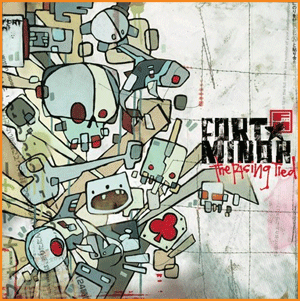
From: http://asianvariations.com/images/fortminor-album.gif
My outside reading book

From: www.illiterarty.com/files/www.illiterarty.com/img/119/a_thousand_splendid_suns.jpg