My 4th Quarter Outside Reading Book

My 4th Quarter Outside Reading Book
from whatcouldzoosbe.files.wordpress.com/2007/08/life-of-pi.jpg

Tuesday, November 27, 2007

On The Waterfront Paper

A 400 Blows Repeat

Movie theaters always have the latest dramas, thrillers and action packed films. Here in Edina at AMC theaters, thousands of people pay seven dollars to see the hottest new releases like American Gangster and Beowulf. However, there never seem to be any old or classic movies playing. Why? The answer is quite simple. The vast majority of people don’t want to waste their time watching outdated black and white movies. The movie, On The Waterfront directed by Elia Kazan is no exception. Tom.s.lol once asked me if it was an effective movie, and I replied, “Yes, it was very effective bringing bile to my mouth.” While the literary aspects of the film were spectacular, the dramatic and cinematic aspects were terrible, and made the film feel gaudy and cheap. The bottom line is, On The Waterfront never was, and never will be a good movie.

Of the literary aspects, characters, setting and themes are the strongest and provide a good story to keep the viewer dying to find out what happens next. Unlike The 400 Blows, On The Waterfront is successful at gaining the viewers sympathy for the main character, Terry Malloy, which is a crucial part in developing movie characters. This allows the viewer to relate to Terry and feel as if they have a personal connection with him. The movie also does a good job developing the characters in opposition to Terry Malloy. Johnny Friendly, the mob boss, is portrayed as an assertive man who is the complete opposite of Terry Malloy. These two characters drive the main conflict and create the action and suspense.

The setting is another strong portion of the literary aspects. Because it was made in 1954, the time period makes this movie unique. It is especially appealing to kids and teenagers today because we get experience a different era and get a glimpse at what life was like during that time period. The setting plays an important part in deciding what conflicts take place in the movie. The basis for this movie is a mob that takes over the waterfront and controls who gets jobs and who doesn’t; this creates a problem for the common people. This conflict is only possible because of the time period it is set in.

The most important literary aspects are the dilemmas and themes. Terry Malloy is faced with the choice to keep his mouth shut about a murder and keep his job in the mob, or to tell the cops who did the killing and risk his own life. While this specific dilemma is unique, the theme isn’t. All people have been put in a situation where there are negative outcomes no matter what decision they make. The murder situation that Terry is in makes the movie appealing while the theme gives the viewer a chance to draw upon their own experiences.

Even though On The Waterfront has great potential with its literary aspects, it fails in the dramatic aspects of the film. The actors, and makeup bought tears to my eyes not because they are so spectacular, but because I was laughing at how bad they are. Edie Doyle played by Eva Marie Saint is supposed to be a symbol for what is good but often times her constant crying and screaming makes her come off as annoying. One example is when Edie finds out that Terry Malloy took part in her brother’s murder. She begins a crying like a baby followed by shaking her head and repeatedly saying “how could you?” To my classmates and I, this scene was more comical than emotional. It seems as if she tries too hard to be dramatic which causes the viewer to take her less seriously. Clearly, Eva Marie Saint is not the right person for the part because of her bad acting. One of the more memorable moments is when there is a shot of Terry Malloy after he is beat up by the mob. The blood on his face looks like ketchup and the bruises appear to be black engine-slug from a car. One might claim that On The Waterfront was made a long time ago and their makeup wasn’t that good, but in the movie business, every aspect must be done perfectly.

The cinematic aspects neither contribute to the film, nor hurt it. The director didn’t have much creativity with camera angles or movement. When the mob boss, Johnny Friendly, is shown for the first time, there is a low angle shot of him from the pool table he is standing by. The angle is appropriate, however viewers today have higher standards and come to expect this from movie directors, almost like 9th grade students expect to be spoon-fed an “easy A”. Another example is when Terry Malloy is walking towards the warehouse in the final few scenes of the movie. Instead of just showing Terry stumbling down a sidewalk, the camera goes 1st person and the viewer feels as if they are looking through his eyes. Again, this is nothing special considering that a 3rd person view would have put the viewers to sleep. The worst part is the music that is played in almost every scene. It is load and obnoxious to the point where it almost becomes a character in itself. Overall, the cinematic aspects were bland and typical, showing no creativity on the director’s part.

On The Waterfront shares one common theme with Arthur Miller’s All My Sons, but aside from the theme, always do the right thing, the two are completely different. Both Terry Malloy and Joe Keller face situations where their decisions affect the lives of many other people. Joe’s decision killed 20 air force pilots whereas Terry’s actually saved people’s lives and jobs at the cost of risking his own life. In On The Waterfront, there is a clear cut difference between good and bad and both are represented by Edie Doyle and Johnny Friendly. In All My Sons, there isn’t a clear line between good and bad because there are many personal opinions that play into what the reader decides.

On The Waterfront could have been a classic if it was written as a book due to its unique literary aspects like setting. The dramatic and cinematic aspects, like the music, reduce the movie to a little known, little cared about, piece of film. I would never recommend this movie to anybody, and I definitely don’t think that On The Waterfront will be playing at AMC theaters any time soon.

Monday, November 26, 2007

Week 3 Post B

"If it's a girl, and it isn't, but, if it is a girl, then you can choose whatever name you want."(p.79)

It's interesting to note how much of a difference there is in our culture compared to others like the Middle East and Asia. One specific difference between Afghanistan and the United States is the difference between male dominance and favoritism. In the quote, the husband has his mind made up that his unborn child is going to be a boy. The father even goes as far as buying a boy's fur coat for his new child and picking out only male names. It seems that there is much more importance to the Afghanis to carry on their family name than the United States. Many U.S. citizens wish for a certain gender when having a child, but not to the extreme of creating a boy's bedroom and buying boy's toys before they know if it is going to be a girl or boy. While I may not fully understand why males have always been dominant in Afghanistan, I can say that the differences between there and the United States are remarkably different when it comes to male's roles and superiority.

Week 3 Post A

Definitions

Drab(p.78)- dull; cheerless; lacking in spirit, brightness, etc.
Kinship(p.77)- relationship by nature, qualities, etc.; affinity.

Figurative Language

"It was as though a rainbow had melted into her eyes."(p.78) This is a very unique simile and personification that stood out when I was reading A Thousand Splendid Suns. While we don't generally say that humans "melt", Khaled Hosseini is giving a characteristic to the rainbow that doesn't have. I enjoy these alliterations because each one makes the book that much more interesting to read and shows the creative side to the author.

"Swirling flakes tickled her cheeks."(p.79) Here is another example of personification because we all know that snowflakes can not tickle; unless your tom.s.lol who thinks that anything can happen and he says noob too much and the rest of his 6th period L.A. class laughs for some apparent reason. Anyway, I always thought that I could not snow in Kabul but once again Khaled Hosseini's experience and knowledge of the life around that area has taught me another fact.

"Happiness rushed in like a gust of wind blowing a door wide open. Her eyes watered."(p.80) This is a simile because it uses the word "like" to compare two things. This is when Mariam first finds out that she cooked a good meal for her husband. Since she has to deal with the tragic loss of her mom, it's little things like making a good dinner that bring her the most happiness.

Quote


"When Mariam thought of this baby, her heart swelled inside of her. It swelled and swelled until all the loss, all the grief, all the loneliness and self-abasement of her life washed away."(p.80) this is a very significant quote because in this quote, we learn what Mariam is living for and what her goal is. However, there is some foreshadowing that something bad is going to happen to her baby because everything is going almost too well...

Tuesday, November 20, 2007

Week 2 Post B

Dear Khaled Hosseini,

You never cease to amaze me with your writing talent. I have already read your first book, The Kite Runner, and so far your second book has lived up to all of the standards of your first book and more. The thing that I like most about the books are the unexpected events that keep me glued to the book. I have read many books where the authors make pitiful attempts at suspense and surprise twists but you have a way at making the story flow even when there is a life shattering event. The use of foreign words also adds to the book. Besides the obvious "makes it more authentic" purpose, I feel that it demonstrates your knowledge as well as your experience when your write about these topics. I feel as if I can trust you and take your word when you talk about some tragic events that happen in Afghanistan.

Week 2 Post A

Definitions

aggrieved (p.27)- to oppress or wrong grievously; injure by injustice.
disillusionment (p.33)- to free from or deprive of illusion, belief, idealism, etc.

Figurative Language

"She ran her fingers along the hood of Jalil's car, which was black, shiny, with glittering wheels in which Mariam saw a flattened, widened version of herself." (p.30) The car, is an example of a symbol. Mariam pictures this car as the beautiful side of herself and as something that can do no wrong. Mariam is constantly striving to be loved and accepted, and she views the car as something that is exactly that.

"The treetops swayed in the breeze, and she imagined they were nodding their welcome to her" (p.30) This is personification because it gives human traits to objects. It's little things like these that make to book so entertaining that I can barely bring myself to put the book down.

"Paper-thin skin" (p.32) Aside from the fact that this rhymes, it is a simily because it compares two thing in order to describe something.

Quote

"She walked on a maroon carpet with a repeating blue-and-yellow octagonal pattern." This quote reminds me of when I was a little kid. Since I was very short, I tended to look at the ground a lot and I noticed the patterns just like Mariam. I remember how my mom would always go to the dry cleaners on Wednesday and I would hop around the carpet and try to stay on the curvy lines and patterns that were in the carpet.

Week 1 Post B

"Learn this now and learn it well, my daughter: Like a compass needle that points north, a man's accusing finger always finds a woman. Always." (p.7)

MALE SUPREMACY! Often times, we like to think that women are exactly the same as men when it comes to roles in society. But even when women have the same constitutional rights as men, our society still sets out different standards for men and women. For example, we generally think it is ok for a women to stay at home and take care of the house. In fact, it is considered a sign of wealth if a wife can stay home. However, if a husband stays home while the mother works, people would think it's creepy and that the husband is down right lazy. From the knowledge I have gained from my AP World class, this has been happening since the very beginning of time in Mesopotamia (Not that the AP Euro students would know this TOM AND AMY!) The two genders have always played unique roles in the development of society but the males in each culture seem to dominate. I am not saying that males are better, I'm simply saying that women and men aren't as equal as we would like them to be.

Week 1 Post A

Definitions

deflated (p.22)- to depress or reduce (a person or a person's ego, hopes, spirits, etc.); puncture; dash
forlorn (p.25)- desolate or dreary; unhappy or miserable, as in feeling, condition, or appearance.

Figurative language

"To Jalil and his wives, I was a pokeroot. A mugwort."(p.8) Obviously, Mariam is not a type of weed. However, the author uses this metaphor to the point across that she was somebody who wasn't wanted as a child and they actually tried to get rid of her but failed.

"What's the sense schooling a gril like you? It's like shining a spittoon." (p.17) In this quote, Khaled Hosseini, uses a simile to compare the main character to a spittoon. Many people feel as if she isn't worth schooling because she was the result of an affair and the father doesn't want her.

This next quote isn't exactly like a metaphor but it does show the mother's views on Mariam when she tells her that she is nothing and will become nothing. "I'm the only one who loves you. I'm all you have in this world, Mariam, and when I'm gone you'll have nothing. You'll have nothing. You
are nothing!" (p.26)

Quote

"You're afraid, Nana. You're afraid that I might find the happiness you haver had. And you don't want me to be happy. You don't want a good life for me. You're the one with the wretched heart."

This is Mariam's way of rebelling against her mother who constantly puts her down and tells her that she is worthless and not wanted by anybody. In a ways, she seems a lot like me, with her cocky attitude against her parents. I have the same attitude with my parents whether I'm just acting tough or pretending I don't care. Why do I do it? To show that I am cooler than they are and that I am in control of my life which freaks my parents out. Most of the time, I end up with some punishment and even being grounded for the weekend. While the punishments do suck, it's worth it to show them that I am the same invincible, cocky, and mischievous boy that they will always have.

Theme

There really isn't a main theme yet because the author doesn't introduce the main conflict until about the 10th chapter. However, I can say that one side-theme is that women shouldn't concede to men just because of their gender.

My outside reading book

My outside reading book
From: books.beloblog.com/archives/roadhardcover.jpg

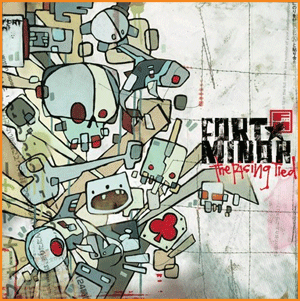
The Rising Tied Album

The Rising Tied Album
From: http://asianvariations.com/images/fortminor-album.gif

My outside reading book

My outside reading book
From: www.illiterarty.com/files/www.illiterarty.com/img/119/a_thousand_splendid_suns.jpg

My outside reading Memoir

My outside reading Memoir