For this week I decided to write about an event that has always happened to me but was never brought to my at attention until I read A Thousand Splendid Suns. The two main characters, who are in love, are watching a romantic movie together.
"On the screen, Alyona and her new husband locked lips. Watching the kiss, Laila felt strangely conspicuous all at once. She became intensely aware of her heart thumping, of the blood thudding in her ears, of the shape of Tariq beside her, tightening up, becoming still."(141)
I think that this has happened to almost everybody at one point in their life or another. Personally, this has happened to me when watching movies with my friends. Everybody knows that there has to be at least one romantic scene in a movie and when it finally comes, everybody is too afraid to make even the slightest movements. Even being the person that I am, jokes never seem appropriate during a make out scene in a movie.
My 4th Quarter Outside Reading Book

from whatcouldzoosbe.files.wordpress.com/2007/08/life-of-pi.jpg
Tuesday, December 18, 2007

Week 6 Post A
Definitions
For this week, I came across many words that I didn't know.
Conspicuous (141)-attracting special attention, as by outstanding qualities or eccentricities
Anew (144)-over again; again; once more
indomitable (144)-that cannot be subdued or overcome, as persons, will, or courage; unconquerable
Circuitous (146)-roundabout; not direct
Cretinous (153)-a person suffering from cretinism.
Figurative Language
"Tariq napped beneath a tree on the banks of a gurgling stream"(137). The gurgling stream is an example of personification. The human trait of gurgling gives the stream a characteristic that all readers can picture in their head.
"The children tearing after each other around the house"(149). I thought that this quote was unique because just one word can give the reader an idea of what the party was like. The word tearing, although not used for its literal meaning, implies a sense of chaos and screaming from the children even though the author never directly states it.
"The city held its breath"(155). This is describing right after the first bombings take place in Kabul. This could be a type of personification but most of all, it gives a "big picture" to the reader so they can keep track of what is happening.
Quote
"The Mujahideen, armed to the teeth but now lacking a common enemy, had found the enemy in each other"(155) This goes along with my topic for my research paper as gun control. It is clear that when any group of people have a stockpile of guns, their most likely going to use them in one way or another. Besides my paper, this creates the main conflict in the story and Laila's life seems to be dictated by the war that is happening around her, as her life is slowly spinning out of control.
Theme
Laila finds a new relationship with a man named Tariq and in times of the chaos and violence that takes place all around them, their love is the one constant that they can count on.
For this week, I came across many words that I didn't know.
Conspicuous (141)-attracting special attention, as by outstanding qualities or eccentricities
Anew (144)-over again; again; once more
indomitable (144)-that cannot be subdued or overcome, as persons, will, or courage; unconquerable
Circuitous (146)-roundabout; not direct
Cretinous (153)-a person suffering from cretinism.
Figurative Language
"Tariq napped beneath a tree on the banks of a gurgling stream"(137). The gurgling stream is an example of personification. The human trait of gurgling gives the stream a characteristic that all readers can picture in their head.
"The children tearing after each other around the house"(149). I thought that this quote was unique because just one word can give the reader an idea of what the party was like. The word tearing, although not used for its literal meaning, implies a sense of chaos and screaming from the children even though the author never directly states it.
"The city held its breath"(155). This is describing right after the first bombings take place in Kabul. This could be a type of personification but most of all, it gives a "big picture" to the reader so they can keep track of what is happening.
Quote
"The Mujahideen, armed to the teeth but now lacking a common enemy, had found the enemy in each other"(155) This goes along with my topic for my research paper as gun control. It is clear that when any group of people have a stockpile of guns, their most likely going to use them in one way or another. Besides my paper, this creates the main conflict in the story and Laila's life seems to be dictated by the war that is happening around her, as her life is slowly spinning out of control.
Theme
Laila finds a new relationship with a man named Tariq and in times of the chaos and violence that takes place all around them, their love is the one constant that they can count on.
Tuesday, December 11, 2007
Week 5 Post B
Letter to the author:
Dear Khaled Hosseini,
I am only half way through your book but I am amazed at your use of imagery to describe such wonderful features of the main characters' lives. Everything from the floor that they walk on, to the statues that they visit, are all described very well. What sets this book apart from others is that you have a way of keeping the description and details interesting rather then putting details in the book because you have to. The details are just as much a part of the book as the diolauge is. One thing that I felt could have been better was the transition from Mariam to Laila. There was nothing to warn the reader and when the transition happened I got very confused. I had to read very carefully and sometimes read it twice just to get who you were talking about. I can not wait to finish this book and I hope you come out with another book very soon!
Dear Khaled Hosseini,
I am only half way through your book but I am amazed at your use of imagery to describe such wonderful features of the main characters' lives. Everything from the floor that they walk on, to the statues that they visit, are all described very well. What sets this book apart from others is that you have a way of keeping the description and details interesting rather then putting details in the book because you have to. The details are just as much a part of the book as the diolauge is. One thing that I felt could have been better was the transition from Mariam to Laila. There was nothing to warn the reader and when the transition happened I got very confused. I had to read very carefully and sometimes read it twice just to get who you were talking about. I can not wait to finish this book and I hope you come out with another book very soon!
Week 5 Post A
Definitions
Flaccid(p112)- lacking force; weak
Admonishing(p115)- To counsel (another) against something to be avoided; caution.
Figurative Language
"...The carcasses of burned-out Soviet tanks and wrecked helicopters"(p132). This is a good use of imagery because it forces the reader to recall previous know and images that they see in magazines and newspapers. It gives the reader a better connection between the book and the current events happening in their everyday lives.
"The fields were bordered by poplars and crisscrossed by streams and irrigation ditches, on the banks of which tiny female figures squatted and washed clothes. Babi pointed to rice paddies and barley fields draping the slopes"(p134). This quote has a little bit of every type of figurative language. First off, there is lots of imagery that gives the reader a vivid account of exactly what Laila is seeing. Second, there is also some alliteration which makes this quote unique. I don't know if Hosseini intended to put it in there but when he says, "bordered by poplars and crisscrossed by streams" it sounds like alliteration because of the repetition of the vowel sounds.
"A hand emerged, like a submarine periscope breaking surface, and dropped"(p110). This is a good example of a simile because it uses the world "like" to compare the mother's arm to a submarine periscope.
Quote
"Mammy lay in bed most days. She wore black... The ailments that would hound Mammy for the rest of her days began. Chest pains and headaches, joint aches and night sweats, paralyzing pains in her ears, lumps no one else could feel."(p126).
I think that the mother has to man up and accept her sons deaths. Sure deaths are very hard to deal with, but she has got a family to run and she isn't dealing with her problems. All she is doing is putting them off and forcing the rest of the family to take care of her. She's dead weight. Emotionally-concious people like Amy, would argue that she can't help feeling sad for the deaths of her two sons, and she would be right except the mother's constant 24-7 mourning has caused Laila (the daughter) to be less focused in school, their house is a mess, their marriage is in trouble, and the father and Laila want to leave the mom behind! In other words, the mother is a waste of a human life!
Theme
As we see more and more of the mother's uselessness, we learn to not mourn a loved one for too long. It is best for you and everybody around you if it does not affect your everyday life.
Flaccid(p112)- lacking force; weak
Admonishing(p115)- To counsel (another) against something to be avoided; caution.
Figurative Language
"...The carcasses of burned-out Soviet tanks and wrecked helicopters"(p132). This is a good use of imagery because it forces the reader to recall previous know and images that they see in magazines and newspapers. It gives the reader a better connection between the book and the current events happening in their everyday lives.
"The fields were bordered by poplars and crisscrossed by streams and irrigation ditches, on the banks of which tiny female figures squatted and washed clothes. Babi pointed to rice paddies and barley fields draping the slopes"(p134). This quote has a little bit of every type of figurative language. First off, there is lots of imagery that gives the reader a vivid account of exactly what Laila is seeing. Second, there is also some alliteration which makes this quote unique. I don't know if Hosseini intended to put it in there but when he says, "bordered by poplars and crisscrossed by streams" it sounds like alliteration because of the repetition of the vowel sounds.
"A hand emerged, like a submarine periscope breaking surface, and dropped"(p110). This is a good example of a simile because it uses the world "like" to compare the mother's arm to a submarine periscope.
Quote
"Mammy lay in bed most days. She wore black... The ailments that would hound Mammy for the rest of her days began. Chest pains and headaches, joint aches and night sweats, paralyzing pains in her ears, lumps no one else could feel."(p126).
I think that the mother has to man up and accept her sons deaths. Sure deaths are very hard to deal with, but she has got a family to run and she isn't dealing with her problems. All she is doing is putting them off and forcing the rest of the family to take care of her. She's dead weight. Emotionally-concious people like Amy, would argue that she can't help feeling sad for the deaths of her two sons, and she would be right except the mother's constant 24-7 mourning has caused Laila (the daughter) to be less focused in school, their house is a mess, their marriage is in trouble, and the father and Laila want to leave the mom behind! In other words, the mother is a waste of a human life!
Theme
As we see more and more of the mother's uselessness, we learn to not mourn a loved one for too long. It is best for you and everybody around you if it does not affect your everyday life.
Tuesday, December 4, 2007
Week 4 Post B
"She was always scowling, and walking with her books pressed to her chest, like a sheild"(p.102)
I have noticed that in Edina, girls and boys carry their books and notebooks very differently. The most apparent difference can be seen at Southview Middle School. For some unexplained reason, girls carry their books against their chests, almost "hugging" their books whereas guys, carry their books by their side, using one arm and their hip. Even more striking, is that every single guy and girl follows the trends for their gender. So why do guys and girls carry their books so differently if they all have the same books? The answer may suggest male strength superiority. Guys generally have more upper body strength in the shoulders and triceps which allows them to carry their books with most of the weight on the upper portion of the arm. Girls however, place their books on their hips, which carry most of the weight and use their arm to balance the book. At EHS, most people walk around with their backpacks which takes away this difference. I wrote this mostly as a thought provoking and entertaining paragraph. Please do not take the things I said as facts. Male strength superiority is just one theory why guys and girls carry their books differently.
I have noticed that in Edina, girls and boys carry their books and notebooks very differently. The most apparent difference can be seen at Southview Middle School. For some unexplained reason, girls carry their books against their chests, almost "hugging" their books whereas guys, carry their books by their side, using one arm and their hip. Even more striking, is that every single guy and girl follows the trends for their gender. So why do guys and girls carry their books so differently if they all have the same books? The answer may suggest male strength superiority. Guys generally have more upper body strength in the shoulders and triceps which allows them to carry their books with most of the weight on the upper portion of the arm. Girls however, place their books on their hips, which carry most of the weight and use their arm to balance the book. At EHS, most people walk around with their backpacks which takes away this difference. I wrote this mostly as a thought provoking and entertaining paragraph. Please do not take the things I said as facts. Male strength superiority is just one theory why guys and girls carry their books differently.
Week 4 Post A
Definitions
Mundane(p.89)- common; ordinary; banal; unimaginative
Indomitable(p.98)- that cannot be subdued or overcome, as persons, will, or courage; unconquerable
Figurative language
"his glasses perched on the tip of his nose."(p.89-99) This is an example of alliteration. His glasses, which are an inanimate object, are given human characteristics (or in this case bird characteristics). This gives the reader a sense of what the glasses looked like, how big they were, and what his face looked like all in one short sentence.
"Giti said she ran like a sewing machine."(p.102) I don't really know how someone runs like a sewing machine especially since sewing machines don't move. This is an example of a simile because it uses the word "like" to compare two completely different things. This quote adds uniqueness to the main character and gives the reader something to remember her by.
"Where he labored amid the heat and the humming machinery stoking the massive ovens and mill grains all day."(p.103) Once again, the machinery is given the human characteristic of "humming." This alliteration gives the reader a better sense of the father's background as well as keeping the reader entertained.
Quote
"Through the mouthful of grit and pebbles, Mariam mumbled a plea. Tears were leaking out of the corners of her eyes.
'CHEW!' he bellowed...
Mariam chewed. Something in the back of her mouth cracked.
'Good, now you know what your rice tastes like.'
Then he was gone, leaving Mariam to spit out pebbles, blood, and the fragments of two broken molars."(p.94)
Here is one example of the spouse abuse that Mariam, the main character, has to put up with. She tries desperately to fix the problem but she has no family of friends she can turn to, to help her with her problem.
Theme
Spouse abuse seems to be an important theme. Khaled Hosseini uses the subject of abuse as the main conflict. Mariam is constantly put down by her husband and is beaten too. Hosseini also uses spouse abuse to create a side-theme about the strength and equality of women.
Mundane(p.89)- common; ordinary; banal; unimaginative
Indomitable(p.98)- that cannot be subdued or overcome, as persons, will, or courage; unconquerable
Figurative language
"his glasses perched on the tip of his nose."(p.89-99) This is an example of alliteration. His glasses, which are an inanimate object, are given human characteristics (or in this case bird characteristics). This gives the reader a sense of what the glasses looked like, how big they were, and what his face looked like all in one short sentence.
"Giti said she ran like a sewing machine."(p.102) I don't really know how someone runs like a sewing machine especially since sewing machines don't move. This is an example of a simile because it uses the word "like" to compare two completely different things. This quote adds uniqueness to the main character and gives the reader something to remember her by.
"Where he labored amid the heat and the humming machinery stoking the massive ovens and mill grains all day."(p.103) Once again, the machinery is given the human characteristic of "humming." This alliteration gives the reader a better sense of the father's background as well as keeping the reader entertained.
Quote
"Through the mouthful of grit and pebbles, Mariam mumbled a plea. Tears were leaking out of the corners of her eyes.
'CHEW!' he bellowed...
Mariam chewed. Something in the back of her mouth cracked.
'Good, now you know what your rice tastes like.'
Then he was gone, leaving Mariam to spit out pebbles, blood, and the fragments of two broken molars."(p.94)
Here is one example of the spouse abuse that Mariam, the main character, has to put up with. She tries desperately to fix the problem but she has no family of friends she can turn to, to help her with her problem.
Theme
Spouse abuse seems to be an important theme. Khaled Hosseini uses the subject of abuse as the main conflict. Mariam is constantly put down by her husband and is beaten too. Hosseini also uses spouse abuse to create a side-theme about the strength and equality of women.
Tuesday, November 27, 2007
On The Waterfront Paper
A 400 Blows Repeat
Movie theaters always have the latest dramas, thrillers and action packed films. Here in
Of the literary aspects, characters, setting and themes are the strongest and provide a good story to keep the viewer dying to find out what happens next. Unlike The 400 Blows, On The Waterfront is successful at gaining the viewers sympathy for the main character, Terry Malloy, which is a crucial part in developing movie characters. This allows the viewer to relate to Terry and feel as if they have a personal connection with him. The movie also does a good job developing the characters in opposition to Terry Malloy. Johnny Friendly, the mob boss, is portrayed as an assertive man who is the complete opposite of Terry Malloy. These two characters drive the main conflict and create the action and suspense.
The setting is another strong portion of the literary aspects. Because it was made in 1954, the time period makes this movie unique. It is especially appealing to kids and teenagers today because we get experience a different era and get a glimpse at what life was like during that time period. The setting plays an important part in deciding what conflicts take place in the movie. The basis for this movie is a mob that takes over the waterfront and controls who gets jobs and who doesn’t; this creates a problem for the common people. This conflict is only possible because of the time period it is set in.
The most important literary aspects are the dilemmas and themes. Terry Malloy is faced with the choice to keep his mouth shut about a murder and keep his job in the mob, or to tell the cops who did the killing and risk his own life. While this specific dilemma is unique, the theme isn’t. All people have been put in a situation where there are negative outcomes no matter what decision they make. The murder situation that Terry is in makes the movie appealing while the theme gives the viewer a chance to draw upon their own experiences.
Even though On The Waterfront has great potential with its literary aspects, it fails in the dramatic aspects of the film. The actors, and makeup bought tears to my eyes not because they are so spectacular, but because I was laughing at how bad they are. Edie Doyle played by Eva Marie Saint is supposed to be a symbol for what is good but often times her constant crying and screaming makes her come off as annoying. One example is when Edie finds out that Terry Malloy took part in her brother’s murder. She begins a crying like a baby followed by shaking her head and repeatedly saying “how could you?” To my classmates and I, this scene was more comical than emotional. It seems as if she tries too hard to be dramatic which causes the viewer to take her less seriously. Clearly, Eva Marie Saint is not the right person for the part because of her bad acting. One of the more memorable moments is when there is a shot of Terry Malloy after he is beat up by the mob. The blood on his face looks like ketchup and the bruises appear to be black engine-slug from a car. One might claim that On The Waterfront was made a long time ago and their makeup wasn’t that good, but in the movie business, every aspect must be done perfectly.
The cinematic aspects neither contribute to the film, nor hurt it. The director didn’t have much creativity with camera angles or movement. When the mob boss, Johnny Friendly, is shown for the first time, there is a low angle shot of him from the pool table he is standing by. The angle is appropriate, however viewers today have higher standards and come to expect this from movie directors, almost like 9th grade students expect to be spoon-fed an “easy A”. Another example is when Terry Malloy is walking towards the warehouse in the final few scenes of the movie. Instead of just showing Terry stumbling down a sidewalk, the camera goes 1st person and the viewer feels as if they are looking through his eyes. Again, this is nothing special considering that a 3rd person view would have put the viewers to sleep. The worst part is the music that is played in almost every scene. It is load and obnoxious to the point where it almost becomes a character in itself. Overall, the cinematic aspects were bland and typical, showing no creativity on the director’s part.
On The Waterfront shares one common theme with Arthur Miller’s All My Sons, but aside from the theme, always do the right thing, the two are completely different. Both Terry Malloy and Joe Keller face situations where their decisions affect the lives of many other people. Joe’s decision killed 20 air force pilots whereas Terry’s actually saved people’s lives and jobs at the cost of risking his own life. In On The Waterfront, there is a clear cut difference between good and bad and both are represented by Edie Doyle and Johnny Friendly. In All My Sons, there isn’t a clear line between good and bad because there are many personal opinions that play into what the reader decides.
On The Waterfront could have been a classic if it was written as a book due to its unique literary aspects like setting. The dramatic and cinematic aspects, like the music, reduce the movie to a little known, little cared about, piece of film. I would never recommend this movie to anybody, and I definitely don’t think that On The Waterfront will be playing at AMC theaters any time soon.
Monday, November 26, 2007
Week 3 Post B
"If it's a girl, and it isn't, but, if it is a girl, then you can choose whatever name you want."(p.79)
It's interesting to note how much of a difference there is in our culture compared to others like the Middle East and Asia. One specific difference between Afghanistan and the United States is the difference between male dominance and favoritism. In the quote, the husband has his mind made up that his unborn child is going to be a boy. The father even goes as far as buying a boy's fur coat for his new child and picking out only male names. It seems that there is much more importance to the Afghanis to carry on their family name than the United States. Many U.S. citizens wish for a certain gender when having a child, but not to the extreme of creating a boy's bedroom and buying boy's toys before they know if it is going to be a girl or boy. While I may not fully understand why males have always been dominant in Afghanistan, I can say that the differences between there and the United States are remarkably different when it comes to male's roles and superiority.
It's interesting to note how much of a difference there is in our culture compared to others like the Middle East and Asia. One specific difference between Afghanistan and the United States is the difference between male dominance and favoritism. In the quote, the husband has his mind made up that his unborn child is going to be a boy. The father even goes as far as buying a boy's fur coat for his new child and picking out only male names. It seems that there is much more importance to the Afghanis to carry on their family name than the United States. Many U.S. citizens wish for a certain gender when having a child, but not to the extreme of creating a boy's bedroom and buying boy's toys before they know if it is going to be a girl or boy. While I may not fully understand why males have always been dominant in Afghanistan, I can say that the differences between there and the United States are remarkably different when it comes to male's roles and superiority.
Week 3 Post A
Definitions
Drab(p.78)- dull; cheerless; lacking in spirit, brightness, etc.
Kinship(p.77)- relationship by nature, qualities, etc.; affinity.
Figurative Language
"It was as though a rainbow had melted into her eyes."(p.78) This is a very unique simile and personification that stood out when I was reading A Thousand Splendid Suns. While we don't generally say that humans "melt", Khaled Hosseini is giving a characteristic to the rainbow that doesn't have. I enjoy these alliterations because each one makes the book that much more interesting to read and shows the creative side to the author.
"Swirling flakes tickled her cheeks."(p.79) Here is another example of personification because we all know that snowflakes can not tickle; unless your tom.s.lol who thinks that anything can happen and he says noob too much and the rest of his 6th period L.A. class laughs for some apparent reason. Anyway, I always thought that I could not snow in Kabul but once again Khaled Hosseini's experience and knowledge of the life around that area has taught me another fact.
"Happiness rushed in like a gust of wind blowing a door wide open. Her eyes watered."(p.80) This is a simile because it uses the word "like" to compare two things. This is when Mariam first finds out that she cooked a good meal for her husband. Since she has to deal with the tragic loss of her mom, it's little things like making a good dinner that bring her the most happiness.
Quote
"When Mariam thought of this baby, her heart swelled inside of her. It swelled and swelled until all the loss, all the grief, all the loneliness and self-abasement of her life washed away."(p.80) this is a very significant quote because in this quote, we learn what Mariam is living for and what her goal is. However, there is some foreshadowing that something bad is going to happen to her baby because everything is going almost too well...
Drab(p.78)- dull; cheerless; lacking in spirit, brightness, etc.
Kinship(p.77)- relationship by nature, qualities, etc.; affinity.
Figurative Language
"It was as though a rainbow had melted into her eyes."(p.78) This is a very unique simile and personification that stood out when I was reading A Thousand Splendid Suns. While we don't generally say that humans "melt", Khaled Hosseini is giving a characteristic to the rainbow that doesn't have. I enjoy these alliterations because each one makes the book that much more interesting to read and shows the creative side to the author.
"Swirling flakes tickled her cheeks."(p.79) Here is another example of personification because we all know that snowflakes can not tickle; unless your tom.s.lol who thinks that anything can happen and he says noob too much and the rest of his 6th period L.A. class laughs for some apparent reason. Anyway, I always thought that I could not snow in Kabul but once again Khaled Hosseini's experience and knowledge of the life around that area has taught me another fact.
"Happiness rushed in like a gust of wind blowing a door wide open. Her eyes watered."(p.80) This is a simile because it uses the word "like" to compare two things. This is when Mariam first finds out that she cooked a good meal for her husband. Since she has to deal with the tragic loss of her mom, it's little things like making a good dinner that bring her the most happiness.
Quote
"When Mariam thought of this baby, her heart swelled inside of her. It swelled and swelled until all the loss, all the grief, all the loneliness and self-abasement of her life washed away."(p.80) this is a very significant quote because in this quote, we learn what Mariam is living for and what her goal is. However, there is some foreshadowing that something bad is going to happen to her baby because everything is going almost too well...
Tuesday, November 20, 2007
Week 2 Post B
Dear Khaled Hosseini,
You never cease to amaze me with your writing talent. I have already read your first book, The Kite Runner, and so far your second book has lived up to all of the standards of your first book and more. The thing that I like most about the books are the unexpected events that keep me glued to the book. I have read many books where the authors make pitiful attempts at suspense and surprise twists but you have a way at making the story flow even when there is a life shattering event. The use of foreign words also adds to the book. Besides the obvious "makes it more authentic" purpose, I feel that it demonstrates your knowledge as well as your experience when your write about these topics. I feel as if I can trust you and take your word when you talk about some tragic events that happen in Afghanistan.
You never cease to amaze me with your writing talent. I have already read your first book, The Kite Runner, and so far your second book has lived up to all of the standards of your first book and more. The thing that I like most about the books are the unexpected events that keep me glued to the book. I have read many books where the authors make pitiful attempts at suspense and surprise twists but you have a way at making the story flow even when there is a life shattering event. The use of foreign words also adds to the book. Besides the obvious "makes it more authentic" purpose, I feel that it demonstrates your knowledge as well as your experience when your write about these topics. I feel as if I can trust you and take your word when you talk about some tragic events that happen in Afghanistan.
Week 2 Post A
Definitions
aggrieved (p.27)- to oppress or wrong grievously; injure by injustice.
disillusionment (p.33)- to free from or deprive of illusion, belief, idealism, etc.
Figurative Language
"She ran her fingers along the hood of Jalil's car, which was black, shiny, with glittering wheels in which Mariam saw a flattened, widened version of herself." (p.30) The car, is an example of a symbol. Mariam pictures this car as the beautiful side of herself and as something that can do no wrong. Mariam is constantly striving to be loved and accepted, and she views the car as something that is exactly that.
"The treetops swayed in the breeze, and she imagined they were nodding their welcome to her" (p.30) This is personification because it gives human traits to objects. It's little things like these that make to book so entertaining that I can barely bring myself to put the book down.
"Paper-thin skin" (p.32) Aside from the fact that this rhymes, it is a simily because it compares two thing in order to describe something.
Quote
"She walked on a maroon carpet with a repeating blue-and-yellow octagonal pattern." This quote reminds me of when I was a little kid. Since I was very short, I tended to look at the ground a lot and I noticed the patterns just like Mariam. I remember how my mom would always go to the dry cleaners on Wednesday and I would hop around the carpet and try to stay on the curvy lines and patterns that were in the carpet.
aggrieved (p.27)- to oppress or wrong grievously; injure by injustice.
disillusionment (p.33)- to free from or deprive of illusion, belief, idealism, etc.
Figurative Language
"She ran her fingers along the hood of Jalil's car, which was black, shiny, with glittering wheels in which Mariam saw a flattened, widened version of herself." (p.30) The car, is an example of a symbol. Mariam pictures this car as the beautiful side of herself and as something that can do no wrong. Mariam is constantly striving to be loved and accepted, and she views the car as something that is exactly that.
"The treetops swayed in the breeze, and she imagined they were nodding their welcome to her" (p.30) This is personification because it gives human traits to objects. It's little things like these that make to book so entertaining that I can barely bring myself to put the book down.
"Paper-thin skin" (p.32) Aside from the fact that this rhymes, it is a simily because it compares two thing in order to describe something.
Quote
"She walked on a maroon carpet with a repeating blue-and-yellow octagonal pattern." This quote reminds me of when I was a little kid. Since I was very short, I tended to look at the ground a lot and I noticed the patterns just like Mariam. I remember how my mom would always go to the dry cleaners on Wednesday and I would hop around the carpet and try to stay on the curvy lines and patterns that were in the carpet.
Week 1 Post B
"Learn this now and learn it well, my daughter: Like a compass needle that points north, a man's accusing finger always finds a woman. Always." (p.7)
MALE SUPREMACY! Often times, we like to think that women are exactly the same as men when it comes to roles in society. But even when women have the same constitutional rights as men, our society still sets out different standards for men and women. For example, we generally think it is ok for a women to stay at home and take care of the house. In fact, it is considered a sign of wealth if a wife can stay home. However, if a husband stays home while the mother works, people would think it's creepy and that the husband is down right lazy. From the knowledge I have gained from my AP World class, this has been happening since the very beginning of time in Mesopotamia (Not that the AP Euro students would know this TOM AND AMY!) The two genders have always played unique roles in the development of society but the males in each culture seem to dominate. I am not saying that males are better, I'm simply saying that women and men aren't as equal as we would like them to be.
MALE SUPREMACY! Often times, we like to think that women are exactly the same as men when it comes to roles in society. But even when women have the same constitutional rights as men, our society still sets out different standards for men and women. For example, we generally think it is ok for a women to stay at home and take care of the house. In fact, it is considered a sign of wealth if a wife can stay home. However, if a husband stays home while the mother works, people would think it's creepy and that the husband is down right lazy. From the knowledge I have gained from my AP World class, this has been happening since the very beginning of time in Mesopotamia (Not that the AP Euro students would know this TOM AND AMY!) The two genders have always played unique roles in the development of society but the males in each culture seem to dominate. I am not saying that males are better, I'm simply saying that women and men aren't as equal as we would like them to be.
Week 1 Post A
Definitions
deflated (p.22)- to depress or reduce (a person or a person's ego, hopes, spirits, etc.); puncture; dash
forlorn (p.25)- desolate or dreary; unhappy or miserable, as in feeling, condition, or appearance.
Figurative language
"To Jalil and his wives, I was a pokeroot. A mugwort."(p.8) Obviously, Mariam is not a type of weed. However, the author uses this metaphor to the point across that she was somebody who wasn't wanted as a child and they actually tried to get rid of her but failed.
"What's the sense schooling a gril like you? It's like shining a spittoon." (p.17) In this quote, Khaled Hosseini, uses a simile to compare the main character to a spittoon. Many people feel as if she isn't worth schooling because she was the result of an affair and the father doesn't want her.
This next quote isn't exactly like a metaphor but it does show the mother's views on Mariam when she tells her that she is nothing and will become nothing. "I'm the only one who loves you. I'm all you have in this world, Mariam, and when I'm gone you'll have nothing. You'll have nothing. You are nothing!" (p.26)
Quote
"You're afraid, Nana. You're afraid that I might find the happiness you haver had. And you don't want me to be happy. You don't want a good life for me. You're the one with the wretched heart."
This is Mariam's way of rebelling against her mother who constantly puts her down and tells her that she is worthless and not wanted by anybody. In a ways, she seems a lot like me, with her cocky attitude against her parents. I have the same attitude with my parents whether I'm just acting tough or pretending I don't care. Why do I do it? To show that I am cooler than they are and that I am in control of my life which freaks my parents out. Most of the time, I end up with some punishment and even being grounded for the weekend. While the punishments do suck, it's worth it to show them that I am the same invincible, cocky, and mischievous boy that they will always have.
Theme
There really isn't a main theme yet because the author doesn't introduce the main conflict until about the 10th chapter. However, I can say that one side-theme is that women shouldn't concede to men just because of their gender.
deflated (p.22)- to depress or reduce (a person or a person's ego, hopes, spirits, etc.); puncture; dash
forlorn (p.25)- desolate or dreary; unhappy or miserable, as in feeling, condition, or appearance.
Figurative language
"To Jalil and his wives, I was a pokeroot. A mugwort."(p.8) Obviously, Mariam is not a type of weed. However, the author uses this metaphor to the point across that she was somebody who wasn't wanted as a child and they actually tried to get rid of her but failed.
"What's the sense schooling a gril like you? It's like shining a spittoon." (p.17) In this quote, Khaled Hosseini, uses a simile to compare the main character to a spittoon. Many people feel as if she isn't worth schooling because she was the result of an affair and the father doesn't want her.
This next quote isn't exactly like a metaphor but it does show the mother's views on Mariam when she tells her that she is nothing and will become nothing. "I'm the only one who loves you. I'm all you have in this world, Mariam, and when I'm gone you'll have nothing. You'll have nothing. You are nothing!" (p.26)
Quote
"You're afraid, Nana. You're afraid that I might find the happiness you haver had. And you don't want me to be happy. You don't want a good life for me. You're the one with the wretched heart."
This is Mariam's way of rebelling against her mother who constantly puts her down and tells her that she is worthless and not wanted by anybody. In a ways, she seems a lot like me, with her cocky attitude against her parents. I have the same attitude with my parents whether I'm just acting tough or pretending I don't care. Why do I do it? To show that I am cooler than they are and that I am in control of my life which freaks my parents out. Most of the time, I end up with some punishment and even being grounded for the weekend. While the punishments do suck, it's worth it to show them that I am the same invincible, cocky, and mischievous boy that they will always have.
Theme
There really isn't a main theme yet because the author doesn't introduce the main conflict until about the 10th chapter. However, I can say that one side-theme is that women shouldn't concede to men just because of their gender.
Tuesday, October 23, 2007
Week 5 Post B
Blood Diamond! I know I'm supposed to be talking about my book, A long Way Gone, but every time I sit down to read it, I can't help but think about the movie Blood Diamond. Both plots and settings match so closely, I thought that the movie was based off of the book but in reality, the movie was made long before Beah wrote his memoir.
There was a particular quote in the novel that matched up almost exactly to the movie. "Because of this raid, Alhaji acquired the name "little Rambo," and he did all he could to live up to that name. My nickname was "Green Snake," because I would situate myself in the most advantageous and sneaky positions."(p.144) In Blood Diamond, the boy soldiers are given names like "Baby killer" and "Blood Reaper" partially to install confidence in the soldiers, but also to strip them of their past lives and identities. In both the movie and the book, it would have been detrimental to the armies to have boy soldiers thinking about their past and who they were. Nicknames ensured that boys would remain loyal to their cause and it provided a sense of family within the army.
Another similarity between the two was the focus on the "boy soldiers." Beah has an obsession writing about his use of drugs. He even goes as far as mentioning them every chapter because they played such a big part in his life. Just like in the memoir, the movie shows scenes were adults give the boy soldiers drugs to make them fearless in battle and feel less pain when they are shot. Without these drugs, the boys would panic and become worthless fighters. It seems that both armies were fueled by drugs; specifically the boy soldiers. Overall, the similarities are quite shocking and I recommend the book and the movie to anybody who can stomach the violence.
Sunday, October 21, 2007
Week 5 Post A
Reverie (p.118)- a state of dreamy meditation or fanciful musing: lost in reverie, a dream.
Jovial (p.177)- endowed with or characterized by a hearty, joyous humor or a spirit of good-fellowship
Appeals
"Other times, the younger boys sat by rocks weeping and telling us that the rocks were their dead families."(p.145) This emotional appeal demonstrates to the reader just how messed up these boy soldiers were from fighting in the war. So much has happened to the boys that none of us will ever be able to understand the pain they went through however this quote allows the reader to gain a perspective of just how badly the kids were hurt.
One part of the book that I found particularly interesting was Beah's behavior after he stopped fighting. "Mambu and Alhaji walked behind me the whole time and consulted with me about which way to proceed, when to stop... It seemed as if we were still in the front line and I was their squad leader."(p.147) It seems that the boys are unable to complete a simple task like walking through a town without being in the war mind set. This habit that they can not break is a logical appeal because operating in squads and being ready to kill has become part of their human nature.
"I was angry because I missed my squad and needed more violence."(p.140) Although this is probably a emotional appeal, to me, this quote is telling me to stay as far away from Ishmael Beah as possible. Therefor it is a logical appeal. HE'S CRAZY! STAY AWAY!
Quote
"It will be a waste of bullets to shoot them, the lieutenant said. So we gave them shovels and demanded, at gunpoint, that they dig their own graves... When they were done digging, we tied them and stabbed their legs with bayonets...We then rolled each man into his hole, and covered them with the wet mud... they laid back and watched us with their pale sad eyes."(p.151) While this quote was extremely painful to read, it also was impossible to tear my eyes away from the page. Most readers enjoy reading about events that they have never experienced and never get to learn about which is why this quote appealed to me. Being buried alive certainly isn't on my "want to know more about" list but because Beah described it in such detail, he was able to get the reader emotionally involved.
Theme
Nothing is too great to overcome and there is always time to change.
Jovial (p.177)- endowed with or characterized by a hearty, joyous humor or a spirit of good-fellowship
Appeals
"Other times, the younger boys sat by rocks weeping and telling us that the rocks were their dead families."(p.145) This emotional appeal demonstrates to the reader just how messed up these boy soldiers were from fighting in the war. So much has happened to the boys that none of us will ever be able to understand the pain they went through however this quote allows the reader to gain a perspective of just how badly the kids were hurt.
One part of the book that I found particularly interesting was Beah's behavior after he stopped fighting. "Mambu and Alhaji walked behind me the whole time and consulted with me about which way to proceed, when to stop... It seemed as if we were still in the front line and I was their squad leader."(p.147) It seems that the boys are unable to complete a simple task like walking through a town without being in the war mind set. This habit that they can not break is a logical appeal because operating in squads and being ready to kill has become part of their human nature.
"I was angry because I missed my squad and needed more violence."(p.140) Although this is probably a emotional appeal, to me, this quote is telling me to stay as far away from Ishmael Beah as possible. Therefor it is a logical appeal. HE'S CRAZY! STAY AWAY!
Quote
"It will be a waste of bullets to shoot them, the lieutenant said. So we gave them shovels and demanded, at gunpoint, that they dig their own graves... When they were done digging, we tied them and stabbed their legs with bayonets...We then rolled each man into his hole, and covered them with the wet mud... they laid back and watched us with their pale sad eyes."(p.151) While this quote was extremely painful to read, it also was impossible to tear my eyes away from the page. Most readers enjoy reading about events that they have never experienced and never get to learn about which is why this quote appealed to me. Being buried alive certainly isn't on my "want to know more about" list but because Beah described it in such detail, he was able to get the reader emotionally involved.
Theme
Nothing is too great to overcome and there is always time to change.
Wednesday, October 17, 2007
Week 4 Post A
Theme
What would you do to cope with the thought of never seeing your family again? Would you cry or would you put it out of your mind forever? Beah uses strangers and friends to help him get through the tough times and he soon learns that a friend can mean the difference between life and death.
Thatched (p.93)-Plant stalks or foliage, such as reeds or palm fronds, used for roofing.
humongous (p.77)- Extremely large; enormous
Appeals
This quote is a very personal quote for me because it reminds me of a death in my family. "What was left of him was only a memory."(86) For me, the emotional part is tough to deal with and it makes me sad to think that nobody will remember you after you die. Sure there will be people in your family who think about you but after the grandchildren die, not even the memory of your existence will survive.
"But I knew that the chances of coming back to the village were slim, as we had no control over our future. We knew only how to survive."(87) I feel bad for Beah because he had no control over what happened to him. People at Edina High School have lots of choices and hold the future in their own hands. Many times, we mistake that as a bad thing when we don't want to study for a test or do homework but really, it is a gift to control our own future.
"Sometimes the night has a way of speaking to us, but we almost never listen."(81) I had to re-read this sentence in the book before I got the actual meaning. Beah is foreshadowing a terrible death to come, but at the same time, he is saying that humans don't think about their consequences of their actions. Global warming immediately comes to my mind when I think about human consequences. This quote shows insight on Beah's part to see that humans can create bad consequences without even knowing it.
Quote
"That night we stole a pot of rice and cassava leaves. We ate it under coffee trees at the edge of the village, washed the pots, and returned them." This quote relates directly to what we have been talking about in class. At what point is it o.k. to steal from others and break the law? In this case, because the reader is able to relate to the main character and knows him very well, I feel that it was justified. I don't believe there is one right answer to the question but I think that most people would sympathize with Beah when he has to steal food to survive.
What would you do to cope with the thought of never seeing your family again? Would you cry or would you put it out of your mind forever? Beah uses strangers and friends to help him get through the tough times and he soon learns that a friend can mean the difference between life and death.
Thatched (p.93)-Plant stalks or foliage, such as reeds or palm fronds, used for roofing.
humongous (p.77)- Extremely large; enormous
Appeals
This quote is a very personal quote for me because it reminds me of a death in my family. "What was left of him was only a memory."(86) For me, the emotional part is tough to deal with and it makes me sad to think that nobody will remember you after you die. Sure there will be people in your family who think about you but after the grandchildren die, not even the memory of your existence will survive.
"But I knew that the chances of coming back to the village were slim, as we had no control over our future. We knew only how to survive."(87) I feel bad for Beah because he had no control over what happened to him. People at Edina High School have lots of choices and hold the future in their own hands. Many times, we mistake that as a bad thing when we don't want to study for a test or do homework but really, it is a gift to control our own future.
"Sometimes the night has a way of speaking to us, but we almost never listen."(81) I had to re-read this sentence in the book before I got the actual meaning. Beah is foreshadowing a terrible death to come, but at the same time, he is saying that humans don't think about their consequences of their actions. Global warming immediately comes to my mind when I think about human consequences. This quote shows insight on Beah's part to see that humans can create bad consequences without even knowing it.
Quote
"That night we stole a pot of rice and cassava leaves. We ate it under coffee trees at the edge of the village, washed the pots, and returned them." This quote relates directly to what we have been talking about in class. At what point is it o.k. to steal from others and break the law? In this case, because the reader is able to relate to the main character and knows him very well, I feel that it was justified. I don't believe there is one right answer to the question but I think that most people would sympathize with Beah when he has to steal food to survive.
Week 4 Post B
"The five men were lined up in front of us on the training ground with their hands tied. We were supposed to slice their throats on the corporal's command. The person whose prisoner died quickest would win the contest... [After the contest] We celebrated that day's achievement with more drugs and more war movies."
It's quotes like these that make me question Ishmael Beah's sanity, therefore I definitely wouldn't want to meet him in person! The quote goes on for another page or so describing how he felt numb to all of the killing and how fiercely loyal he is to his commander. Over the course of three chapters, we see Beah being brainwashed to become a non-sleeping, drug-fueled, killing machine. The story makes it clear how the effects of a war can drastically change one's perception of what is right and what is wrong. One example is the change between Beah's first battle and his later ones. During his first fight, Beah can't bring himself to do anything but curl up into a ball, hide, and cry. But a month later, he finds himself slicing people's throats and laughing at how quickly they fall to the ground.
Many people I know and live with share the same idea about killing. It's wrong and we would never bring ourselves to do it. On the contrary, I believe that Beah's ruthless actions aren’t as far-fetched and unbelievable as we would like to think they are. I feel that most people put in the same situation as Beah, would do the exact same thing.
It's quotes like these that make me question Ishmael Beah's sanity, therefore I definitely wouldn't want to meet him in person! The quote goes on for another page or so describing how he felt numb to all of the killing and how fiercely loyal he is to his commander. Over the course of three chapters, we see Beah being brainwashed to become a non-sleeping, drug-fueled, killing machine. The story makes it clear how the effects of a war can drastically change one's perception of what is right and what is wrong. One example is the change between Beah's first battle and his later ones. During his first fight, Beah can't bring himself to do anything but curl up into a ball, hide, and cry. But a month later, he finds himself slicing people's throats and laughing at how quickly they fall to the ground.
Many people I know and live with share the same idea about killing. It's wrong and we would never bring ourselves to do it. On the contrary, I believe that Beah's ruthless actions aren’t as far-fetched and unbelievable as we would like to think they are. I feel that most people put in the same situation as Beah, would do the exact same thing.
Tuesday, October 9, 2007
Week 3 Post B
I have to say that I'm getting tired of all of the violence in this book. At first, the people who die shock the reader and set the tone for the book. However, after 100 pages of non-stop dying and carnage, it loses it's potency on the reader's emotions. Maybe it's just me, but now I ignore Beah when he is complaining about how bad his feet hurt or how many people he has seen die. The book does incorporate other interesting topics such as jungle survival. I always enjoyed watching Surviverman and Man vs. Wild on the discovery channel and reading about the fruit that Beah eats, the shelters he makes, and the animals he encounters is almost better than the t.v. shows. Overall, I like Beah simplistic and blunt writing style which makes the story easy to get into. On the other hand, I feel that he could do a much better job of making the reader sympathize with him and keeping their interest. In other words, all of the dying gets old.
Week 3 Post A
Quote
For those of you who know E.K. McPimpin, you will enjoy this quote from my novel (That's mostly you Ranjit). "Whenever Alhaji spoke, he used elaborate gestures. It was as if he wanted his already long hand to extend toward whomever he was talking to." I found this quote funny because it is exactly how I picture E.K. My friends and I always joke about how E.K. uses too many "hand gestures" and how he folds his hands at the lunch table. LOL.
Congealed (p.61)- To cause to solidify or coagulate or to undergo a process likened to solidification or coagulation.
Flotsam (p.59)-the part of the wreckage of a ship and its cargo found floating on the water.
Appeals
Jeez! It feels like it is harder to find logical appeals than it is emotional appeals, but I found one. "If you are alive, there is hope for a better day and something good to happen. If there is nothing good left in the destiny of a person, he or she will die."(p.54) This quote is a philosophy on life. Yeah, it gets pretty deep but on a more simple level, it is a logical appeal because it is dealing with human thoughts and how this person thinks about life.
"Sometimes I felt as if the birds gave me angry looks for eating so much of their food."(p.52) It's always good to find a humorous quote to go with some of the more serious ones. This one is an emotional appeal mostly because it evokes lightheartedness from the reader and gives the reader something to laugh about in between all of the blood and guts.
"I was afraid of thinking."(p.50) This is one of those quotes you can think about for a couple minutes but ultimately get nowhere. This is a logical appeal because it forces the reader to think about being afraid of thinking; (yes I did intend for that to be confusing).
Emerging Theme
Don't take things for granted.
For those of you who know E.K. McPimpin, you will enjoy this quote from my novel (That's mostly you Ranjit). "Whenever Alhaji spoke, he used elaborate gestures. It was as if he wanted his already long hand to extend toward whomever he was talking to." I found this quote funny because it is exactly how I picture E.K. My friends and I always joke about how E.K. uses too many "hand gestures" and how he folds his hands at the lunch table. LOL.
Congealed (p.61)- To cause to solidify or coagulate or to undergo a process likened to solidification or coagulation.
Flotsam (p.59)-the part of the wreckage of a ship and its cargo found floating on the water.
Appeals
Jeez! It feels like it is harder to find logical appeals than it is emotional appeals, but I found one. "If you are alive, there is hope for a better day and something good to happen. If there is nothing good left in the destiny of a person, he or she will die."(p.54) This quote is a philosophy on life. Yeah, it gets pretty deep but on a more simple level, it is a logical appeal because it is dealing with human thoughts and how this person thinks about life.
"Sometimes I felt as if the birds gave me angry looks for eating so much of their food."(p.52) It's always good to find a humorous quote to go with some of the more serious ones. This one is an emotional appeal mostly because it evokes lightheartedness from the reader and gives the reader something to laugh about in between all of the blood and guts.
"I was afraid of thinking."(p.50) This is one of those quotes you can think about for a couple minutes but ultimately get nowhere. This is a logical appeal because it forces the reader to think about being afraid of thinking; (yes I did intend for that to be confusing).
Emerging Theme
Don't take things for granted.
Tuesday, October 2, 2007
Week 2 Post B
A letter to the author (Ishmael Beah)
Dear Ishmael Beah,
I must say that you are as blunt as the Brute Hammer with full energy and overshields from Halo 3! It isn't a bad thing; in fact, I enjoy reading your book as a good change of pace. Everything I read for school these days in 10th grade, is very complex and contains lots of hidden and deep morals. I often ask myself "what's the point? Who cares about complex emotions?" Reading your book makes me happy because everything is very straight forward. You don't hide your feelings or emotions and your not afraid to tell people the violent events that occurred in your life. Because your writing style isn't sophisticated, I can better understand the events. The simplistic language even makes for a better overall book and a more memorable one too.
Mark McCool
Dear Ishmael Beah,
I must say that you are as blunt as the Brute Hammer with full energy and overshields from Halo 3! It isn't a bad thing; in fact, I enjoy reading your book as a good change of pace. Everything I read for school these days in 10th grade, is very complex and contains lots of hidden and deep morals. I often ask myself "what's the point? Who cares about complex emotions?" Reading your book makes me happy because everything is very straight forward. You don't hide your feelings or emotions and your not afraid to tell people the violent events that occurred in your life. Because your writing style isn't sophisticated, I can better understand the events. The simplistic language even makes for a better overall book and a more memorable one too.
Mark McCool
Week 2 Post A
Maiming- To disable or disfigure, usually by depriving of the use of a limb or other part of the body.
Okra soup- a shrub bearing beaked pods that is often used for soups.
Appeals
Beah talks about the basic needs of a human to survive on page 29. Much like Black Boy, he becomes weak from starvation and has to resort to stealing little kid's food. "We had yet to learn these things and implement survival tactics, which was what it came down to. That night we were so hungry that we stole people's food while they slept. It was the only way to get through the night." This is a logical appeal because it deals with basic human needs to survive. In Beah's case, it was about his hunger and having the energy to run from the R.U.F.
"That night's journey was very quit... When we got to the village, we sat around the fire until dawn. Not a word was said. Everyone seemed to be in a different world or seemed to be pondering something."(p,36) This is an emotional appeal because it evokes unfamiliar thoughts in the reader. Many people would find it extremely awkward not to talk to people they live around for almost a whole day. Beah writes this to show the reader just how traumatic the killings were.
"One of them caught the fragments of the RPG. He cried out loudly and screamed that he was blind. No one dared to go out and help him."(p.25) This quote is both a logical and emotional appeal. It is logical because no one in their right mind would risk their own life to save one of their townsmen. Secondly it is emotional because the reader feels helpless and wishes that all of the violence could stop.
Quote
"People were terrified of boys our age. Some had heard rumors about young boys being forced by rebels to kill their families and burn their villages. These children now patrolled in special units, Killing and maiming civilians."(p.37)
Most people in the United States today don't even want to hear about the cruelness and heartlessness that is happening all around the world. Beah wants people to be aware of what is really happening rather than being ignorant. This quote goes way beyond kids killing people. It is about what people can be driven to do in desperate times. This quote gives a brief insight to what would happen if our world had no order. Let's just say that people would fear for their life everyday if there was no order!
Theme
The most pressing theme is that chaos and being desperate can push man to do very terrible things only for personal gain.
Okra soup- a shrub bearing beaked pods that is often used for soups.
Appeals
Beah talks about the basic needs of a human to survive on page 29. Much like Black Boy, he becomes weak from starvation and has to resort to stealing little kid's food. "We had yet to learn these things and implement survival tactics, which was what it came down to. That night we were so hungry that we stole people's food while they slept. It was the only way to get through the night." This is a logical appeal because it deals with basic human needs to survive. In Beah's case, it was about his hunger and having the energy to run from the R.U.F.
"That night's journey was very quit... When we got to the village, we sat around the fire until dawn. Not a word was said. Everyone seemed to be in a different world or seemed to be pondering something."(p,36) This is an emotional appeal because it evokes unfamiliar thoughts in the reader. Many people would find it extremely awkward not to talk to people they live around for almost a whole day. Beah writes this to show the reader just how traumatic the killings were.
"One of them caught the fragments of the RPG. He cried out loudly and screamed that he was blind. No one dared to go out and help him."(p.25) This quote is both a logical and emotional appeal. It is logical because no one in their right mind would risk their own life to save one of their townsmen. Secondly it is emotional because the reader feels helpless and wishes that all of the violence could stop.
Quote
"People were terrified of boys our age. Some had heard rumors about young boys being forced by rebels to kill their families and burn their villages. These children now patrolled in special units, Killing and maiming civilians."(p.37)
Most people in the United States today don't even want to hear about the cruelness and heartlessness that is happening all around the world. Beah wants people to be aware of what is really happening rather than being ignorant. This quote goes way beyond kids killing people. It is about what people can be driven to do in desperate times. This quote gives a brief insight to what would happen if our world had no order. Let's just say that people would fear for their life everyday if there was no order!
Theme
The most pressing theme is that chaos and being desperate can push man to do very terrible things only for personal gain.
Tuesday, September 25, 2007
Week 1 Post A
Evoking (p.15)-to call up or produce (memories, feelings, etc.)
Coup (p.14)- a sudden and decisive change of government illegally or by force. Coup can also mean- a highly successful, unexpected stroke, act, or move; a clever action or accomplishment.
Appeals: "It was the first time I had seen a grown man cry like a child, and I felt a sting in my heart." (p.12) Beah lets the reader know directly what he is feeling and some of the shock he is experiencing. This is an emotional appeal because the reader gets to know exactly what Beah is going through.
When Beah sees so many wounded people in his childhood, he goes into a dream-like state and gives and emotional appeal. "Some fainted or vomited. I felt nauseated, and my head was spinning. I felt the ground moving, and people's voices seemed to be far removed from where I stood trembling." Again, Beah is very straight forward and expresses his feelings with the reader freely.
"When the rebels finally came... No one was able to think clearly. In a matter of seconds, people started screaming and running in different directions, pushing and trampling on whoever had fallen on the ground." Beah is describing human nature. He talks about human reactions and therefor is a logical appeal.
Quote: "As we, and others, emerged from the bushes, we saw a man run from the driver's seat to the sidewalk, where he vomited blood. His arm was bleeding. When he stopped vomiting, he began to cry." (p.12)
This quote is written in a very blunt fashion. Ishmael Beah doesn't spare any of the gory details when he is writing about this event. His description of this event even goes on for another page. The quote is so shocking and gives the reader a perspective on what Beah went through even though most people have never experienced events such as the ones he lived through.
Coup (p.14)- a sudden and decisive change of government illegally or by force. Coup can also mean- a highly successful, unexpected stroke, act, or move; a clever action or accomplishment.
Appeals: "It was the first time I had seen a grown man cry like a child, and I felt a sting in my heart." (p.12) Beah lets the reader know directly what he is feeling and some of the shock he is experiencing. This is an emotional appeal because the reader gets to know exactly what Beah is going through.
When Beah sees so many wounded people in his childhood, he goes into a dream-like state and gives and emotional appeal. "Some fainted or vomited. I felt nauseated, and my head was spinning. I felt the ground moving, and people's voices seemed to be far removed from where I stood trembling." Again, Beah is very straight forward and expresses his feelings with the reader freely.
"When the rebels finally came... No one was able to think clearly. In a matter of seconds, people started screaming and running in different directions, pushing and trampling on whoever had fallen on the ground." Beah is describing human nature. He talks about human reactions and therefor is a logical appeal.
Quote: "As we, and others, emerged from the bushes, we saw a man run from the driver's seat to the sidewalk, where he vomited blood. His arm was bleeding. When he stopped vomiting, he began to cry." (p.12)
This quote is written in a very blunt fashion. Ishmael Beah doesn't spare any of the gory details when he is writing about this event. His description of this event even goes on for another page. The quote is so shocking and gives the reader a perspective on what Beah went through even though most people have never experienced events such as the ones he lived through.
Theme: As of right now, Ishamael Beah is very confused with the events that are happening around him. One major theme in the novel is that friends are invaluable. When he is separated from his family, he has only his freinds to help him to escape the RUF soldiers and to keep his moral up.
Thursday, September 13, 2007
Week 1 Post B
People today hear all about wars in other countries, how many people have died, and even stories of how people have been mistreated. Besides all of that, I am always more interested in how and why these conflicts are started. Ishmael Beah makes a very interesting point when he writes,
“I had heard from adults that this was a revolutionary war, a liberation of the people from corrupt government. But what kind of liberation movement shoots innocent civilians, children, that little girl?”
Reading this book has helped me understand the conflict in Sierra Leone. I learned that the RUF (Revolutionary United Front) was formed to give political freedom back to the citizens after the APC (All People’s Congress) made the country a “one-party state.” While the original intentions of the RUF were good, Beah soon discovers that they are corrupt, are doing terrible things. The RUF forces kill civilians, control cities and install fear among citizens only to increase their personal gain.
“I had heard from adults that this was a revolutionary war, a liberation of the people from corrupt government. But what kind of liberation movement shoots innocent civilians, children, that little girl?”
Reading this book has helped me understand the conflict in Sierra Leone. I learned that the RUF (Revolutionary United Front) was formed to give political freedom back to the citizens after the APC (All People’s Congress) made the country a “one-party state.” While the original intentions of the RUF were good, Beah soon discovers that they are corrupt, are doing terrible things. The RUF forces kill civilians, control cities and install fear among citizens only to increase their personal gain.
Subscribe to:
Comments (Atom)
My outside reading book

From: books.beloblog.com/archives/roadhardcover.jpg
The Rising Tied Album
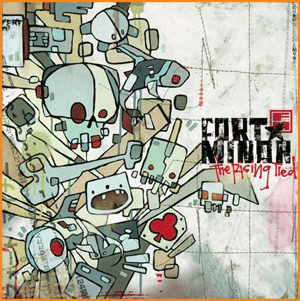
From: http://asianvariations.com/images/fortminor-album.gif
My outside reading book

From: www.illiterarty.com/files/www.illiterarty.com/img/119/a_thousand_splendid_suns.jpg