My 4th Quarter Outside Reading Book

from whatcouldzoosbe.files.wordpress.com/2007/08/life-of-pi.jpg
Tuesday, May 27, 2008
Week 7 Post B
Well, Pi has finally made it to land and he is off the horrible boat that he was confined to for almost 300 days. The book states that his boat washed up on the shores of Mexico. I am not sure how Pi ended up in Mexico but it seems like an unlikely spot to land. When Columbus first followed the winds and currents to the Americas, he hit many island before even reaching Mexico. It took many more years and expeditions for people of his time to get to Mexico. For this reason, I doubt that Pi would randomly wash up on the shores of Mexico without first stopping at some of the other hundred islands. Overall, as the end of this book approaches, I was somewhat disappointed. The overall story had a unique plot but it was a little too unbelievable for my taste. The setup that Yann Martel uses put too much emphasis on Pi's faith. I understand that this is presented as a large portion of the book on purpose but it has negative effects on the book as a whole. Consequently, the book moves painfully slow and failed to gain my sympathy for Pi because of his religious antics. If I had to rate this book I would give it a 6-7 because it has a unique plot but moved too slowly and included too much useless information.

Week 7 Post A
It is astounding to think that Pi has been at sea for 227 day. Chapter 31 includes many famous cast aways however none of their circumstances come close to Pi's predicament. He attributes his success to the fact that he is constantly kept busy physically and spiritually. He prays for most of his day aboard the vessel keeps his mind from thinking about subjects such as his dead family or even his own death. The tiger, believe it or not, is also playing a part in Pi's survival. Although he appears to be nothing but a threat to Pi, the tiger is another living soul that keeps Pi company and keeps him sane. The relationship between Pi and the tiger seems crucial to each others survival. "Success was slow to come, and when it did, it was much appreciated, but the effort seemed out of proportion to the reward. The hours were long, the fish were small, and Richard Parker was forever hungry"(194). The struggle to care for the tiger gives Pi a purpose to survive which supplements his own will to survive.
Tuesday, May 20, 2008
Week 6 Post B
I am amazed at how much there is to write about a boy and a tiger stuck on a life boat. The setting, plot and characters wouldn't seem like an engaging one for the reader however I am always surprised by what happens next. The unpredictable and somewhat ridiculous nature of the novel makes it very entertaining to read. This book is also a lot like Cormac McCarthy's novel "The Road" which also has only two main characters and describes a post-apocalyptic world in which a father and son much survive. Between "The Road" and "Life of Pi" both of the novels share the same themes of survival and love.
Week 6 Post A
Pi's faith seems to be giving him the will power to survive. Pi says, "I was giving up. I would have given up- if a voice hadn't made itself heard in my heart. The voice said, 'I will not die. I refuse it. I will make it through this nightmare. I will beat the odds, as great as they are'...so long as God is with me, I will not die. Amen." I was wondering why Yann Martel was spending so much time describing Pi's faith in three different religions and all of his ideals but now it is clear to me. His faith is the sole element to his survival. It has to be tough being the only one on a raft with weeks of alone time and solidity. I have often heard that tragic events bring a person closer to god but as of right now, Pi is beginning to doubt whether God's love will save him. In a way, these past few chapters have been a proving ground for Pi's faith much like the "land of no return" in the mono myth cycle. Martel shows the reader a glimpse of what Pi's life is like after the shipwreck and the reader finds out that in the end of the story, he has a wife, child and home and is very successful but this doesn't give away the story because I still have no idea what will happen to Pi and how he will become rescued and make it to Canada.
Tuesday, May 13, 2008
Week 5 Post A
It is a lot harder now to blog about a cultural aspect of Pi's life because his ship has just sunk and now he is drifting on his life raft alone with just a few animals. Pi describes each animal with human characteristics calling the hyena a coward and tricking the reader into thinking Richard Parker is really a human. "I creid, Richard Parker, is that you? It's so hard to see. Oh, that this rain would stop! Richard Parker Yes it is you! I could see his head. He was struggling to stay at the surface of the water." At this point Martel had me completely confused because I had never previously heard of this character. Later, after pie throws the life buoy to him, the reader learns that pie is actually describing a giant bangle tiger. The animals that survived and are remaining on the life raft are already competing for survival. The tiger has claimed its territory leaving the rest to fend for themselves and Pi wonders which of the animals will be first in the pecking order. At this point, Pi is still afraid of the tiger and sees him as his main conflict an enemy rather than surviving in the unforgiving environment he is put in.
Week 5 Post B
I am glad the action finally kicked up in this novel. Pi is stranded in the middle of an ocean accompanied by a huge bangle tiger and a hyena. This reminds me a lot of those survivor shows that are played on the History and Discovery channel where survival experts film themselves trying to survive in the harshest places on earth. One particular episode of "Survivorman" on the Discovery channel showed just how difficult it was to survive in a life raft. Many of the problems that he went through are also being faced by Pi. Pi does have one distinct advantage however and that is the storage of food that he discovers in a compartment near the front of the boat. His survival depends on this little storage of food and he quickly calculates that he has enough water to last him 124 day and enough food to last him 94 days which is a huge amount of food and water which should keep him alive until he is rescued. With the food and water problem solved, it will be interesting what will happen between the bangle tiger, hyena and Pi. I suspect that the tiger will probably end up eating the hyena and will need some of Pi's food and water rations.
Tuesday, May 6, 2008
Week 4 Post B
This post is about an interesting twist to the way Life of Pi is written. Chapter 30 is narrated by the author rather than Pi. In previous chapters, this switch in narration confused me because there is nothing to alert the reader that the switch happens however this little trick that Yann Martel uses helps characterize Pi by describing his future self and life. Perhaps even more interesting is the fact that the reader gets to see what happens to Pi near the end of the story without knowing what the transition from Indian life and culture to Canadian life and culture will bring Pi.
Week 4 Post A
"The mid-1970s were troubled times in India...I wasn't interested. The orangutans were as eager for chapattis as ever; the monkeys never asked after the new from Delhi; the rhinos and goats continued to live in peace; the birds twittered; the clouds carried rain; the sun was hot; the earth breathed; God was-there was no Emergency in my world"(78). Pi and myself have more in common that I first thought. In the quote above, Pi expresses his indifference to the conflicts that are taking place in India and the power struggles within the government. For him, every aspect of zoo life is the same and his faith is still strong. I was recently asked to write a two page report on the earthquake in China and the effects on life and civilians. I learned a large amount of facts which allowed me to better comprehend the disaster however I had a tough time relating to the millions who have lost everything they own. I was actually disappointed in myself for not feeling sorry enough. The fact of the matter is that much like Pi's life at his zoo, my world remained largely unchanged. The saying "don't take things for granted" applies in my every day life but I think that one must experience tragedy first-hand before one can truly know.
Wednesday, April 30, 2008
Week 3 post B
I am sick of Pi's religious antics! In addition to being Hindu AND Christian, Pi decides to become Muslim too! After meeting a baker who is Muslim, Pi is fascinated by the physical aspect of praying. I believe that it is wrong to practice three different faiths at the same time and I don't know how Pie is going to do it especially when the different faiths' ideals conflict. Because Pi is still young I feel that his curiosity is getting the best of him and that there is no way that he can remain a Hindu, Christian and Muslim at the same time. This does bring up an interesting point that I have long put in the back of my mind. My grandma, is a lot like Pi because she has created her own sort of religion based on what she has read, heard and liked about different religions. When my father asked her what religion she was she didn't give him a straight answer and a hour long debate followed. Today, I often find it hard to take my faith seriously especially when I have taken AP World. After seeing how strikingly similar every faith was and now ridiculous each faith sounded in a textbook, I question the whether each religion is credible or not. Whether true or not, religion and faith has played a crucial part in one's life ever since the beginning of man.
Week 3 post A
Pi is a very spiritual person who has always been devoted to his religion since birth. Pi is Hindu and is very well educated in his faith. Along with the spiritual beliefs that he has committed in his religion, Pi also ties his real world experiences in and around the zoo to a logical understanding of his faith. For example, Pi believes in reincarnation and believes that the social hierarchy of animals was established by god and that one day himself, along with all the other animals in his zoo might one day become enlightened. He says, "The paths to liberation are numerous, but the bank along the way is always the same, the Bank of Karma, where the liberation account of each of us is credited or debited depending on our actions"(50). In my opinion, all of this sounds fine and dandy but I don't believe I would get along with Pi ideals. In my narrow and arrogant point of view, I see myself as dominant to all animals and I generally don't embrace the "love all nature, respect animals" sort of ideals. It's not so much the difference in religion that would create conflict but Pi's personality. He seems to be an introvert whereas I am almost always an extrovert and enjoy people who are outgoing on confident. Later on in chapter 17, Pi gets his first taste of Christianity but doesn't seem to embrace it well and gets confused when he hears that god sent his son to earth for man's sins. Much like I was confused about Hinduism, Pi tries hard to learn Christianity and even asks if he can be Christian. This is ironic however because immediately after Pi becomes a Christian, he goes to a Hindu temple and prays to thank Lord Krishna.
Wednesday, April 23, 2008
Week 2 Post B
I found it interesting how Yann Martel chose to show Pi's confidence and intelligence through an event where Pi was constantly picked on. It seemed at first that Pi was destined to be a shy book reader who never stood up for himself but after he was confronted with a group of kids who made fun of him at his school, he took the challenge to fight back. Pi's real name is Piscine Molitor Patel but students and even teachers called him "pissing" which enraged him. Pi kept his cool however and created a new nick-name for himself one day by demonstrating his knowledge of the Greek letter Pi. Because of his young age, this came as a shock to his classmates who began to call him "Pi" out of respect. This instance made me think about how a social hierarchy is almost always established when there is a large gathering of people. Whether it's school, work or a party it is human nature to befriend some and put down others. I'm not advocating that this is right, in fact, most people are aware the hurtful things that they do but for some reason do not feel it necessary to stop.
Week 2 Post A
Pi's live revolves around his experiences at the zoo. His father owns the zoo and Pi gets to feed and care for the animals every day. Yann Martel, the author of the book obviously has extensive knowledge about animals and he raises a good point about the freedom of animals in a zoo. He states, "Well-meaning but misinformed people think animals in the wild are "happy"...this is not the way it is. Animals in the wild lead lives of compulsion and necessity within an unforgiving social hierarchy"(16) Martel states that the animals themselves are indifferent to the lives they have in zoos or in the wild. He also points out that with deforestation and the loss of habitat that is happening very rapidly today kills animals whereas the pi's zoo protects them and ensures that they are free from poachers, pollution and disease. Pi is incorporated into the animal hierarchy at this zoo and he has learned what actions are within his rights as a human are permitted by the wild animals.
Wednesday, April 16, 2008
Week 1 Post B
I found the first few pages of the book very entertaining not because it had a lot of action like most stories do to catch a reader's attention, but rather because it described in detail the 3-toed and 2-toed sloth. Martel actually presented an abundance of useless information such as, "If you come upon a sleeping 3-toed sloth in the wild, two or three nudges should suffice to awaken it; it will then look sleepily in every direction but yours"(4). Pi (the main character) is very interested in animals and Martel characterizes pi by demonstrating his knowledge of the three and two toed sloths. The reader feels a personal connection even though Martel doesn't even give a physical description until chapter two. Some other facts that amazed me about the three toed sloth is that they have a algae that grows under their fur which turns brown during the dry season and green during the wet season giving them a natural camo (much like the one in Halo 3). Lastly, Martel even managed to compile enough information about the animal that he writes, "As for hearing, the sloth isn’t not so much deaf as uninterested in sound. Beebe reported that firing guns next to sleeping or feeding sloths elicited little reaction. [Sloths] are said to be able to sniff and avoid decayed branches, but Bullock (1968) reported that sloths fall to the ground clinging to decayed branches 'often'"(4).
Week 1 Post A
"The first time I went to an Indian restaurant in Canada I used my Fingers. The waiter looked at me critically and said, 'Fresh off the boat, are you?' He had no idea how deeply those words wounded me"(7)
The author of Life of Pi is Yann Martel. He has lived in almost every corner of the globe and from his writing, it is clear that the cultural differences he writes about reflect his own experiences and embarrassments throughout his life. The passage above describes a character's first arrival in Canada from India and his first meal at a restaurant. I have mixed feelings about the subject but I believe that the waiter was out of line when he decided to put his customer down. It has to be tough enough traveling to a different continent and getting criticized for the way you normally do things. At the same time however, I do believe that a foreigner should learn the customs of the place where he is learning. Appearing less different will get a foreigner into less trouble (usually). It is human nature to put other people down and in the case of the waiter, he put the main character down because he doesn't get very many foreigners in the small town that he lives in.
The author of Life of Pi is Yann Martel. He has lived in almost every corner of the globe and from his writing, it is clear that the cultural differences he writes about reflect his own experiences and embarrassments throughout his life. The passage above describes a character's first arrival in Canada from India and his first meal at a restaurant. I have mixed feelings about the subject but I believe that the waiter was out of line when he decided to put his customer down. It has to be tough enough traveling to a different continent and getting criticized for the way you normally do things. At the same time however, I do believe that a foreigner should learn the customs of the place where he is learning. Appearing less different will get a foreigner into less trouble (usually). It is human nature to put other people down and in the case of the waiter, he put the main character down because he doesn't get very many foreigners in the small town that he lives in.
Tuesday, April 8, 2008
The reasoning behind my book selection
The Life of Pi
Written by Yann Martel (Born in Spain of Canadian parents. He grew up in Costa Rica, France, Mexico, and Canada.)
I became interested in this book when I saw some of my classmates reading this book. After asking my mom about the book and reading the back cover it seems to have a non-conventional plot line and unique set of events. I have yet to start reading the book but because it is written by a male author, which are obviously better than female authors, and because Yann Martel grew up in a plethora of countries and continents, I hope that this book will be a good and interesting book.
Written by Yann Martel (Born in Spain of Canadian parents. He grew up in Costa Rica, France, Mexico, and Canada.)
I became interested in this book when I saw some of my classmates reading this book. After asking my mom about the book and reading the back cover it seems to have a non-conventional plot line and unique set of events. I have yet to start reading the book but because it is written by a male author, which are obviously better than female authors, and because Yann Martel grew up in a plethora of countries and continents, I hope that this book will be a good and interesting book.
Subscribe to:
Comments (Atom)
My outside reading book

From: books.beloblog.com/archives/roadhardcover.jpg
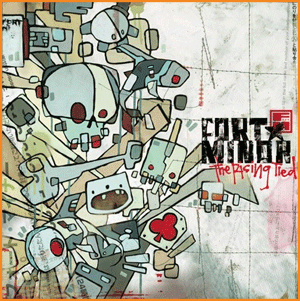
The Rising Tied Album
From: http://asianvariations.com/images/fortminor-album.gif
My outside reading book

From: www.illiterarty.com/files/www.illiterarty.com/img/119/a_thousand_splendid_suns.jpg